
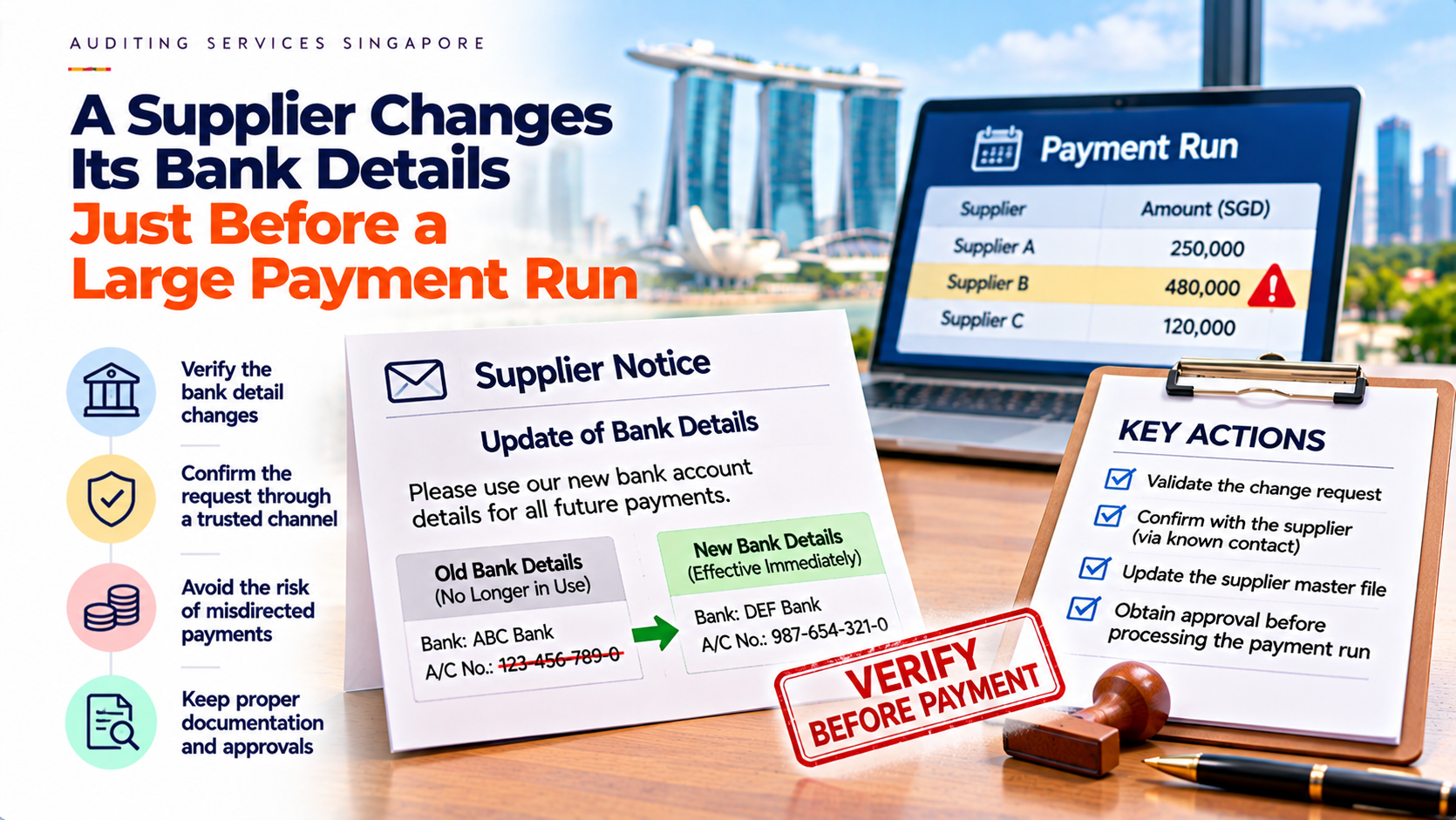
The payment batch is ready for approval when an email arrives from a familiar supplier. It explains that the supplier has changed banks and asks finance to use the new account for an invoice due that afternoon. The message includes the correct invoice number, amount and contact name. Updating the account appears to be a small administrative task.
However, changing the destination of a payment changes a critical part of the transaction. The invoice may be genuine, the goods may have arrived and the amount may already be approved, while the new bank instructions remain unverified. Those are separate questions that need separate checks.
Lee & Hew provides accounting, bookkeeping and internal audit services through Audit Services Singapore. For businesses reviewing their payment processes, supplier bank changes offer a practical starting point: who can request a change, how it is verified and what the final approver can see before money leaves the account.
Separate Invoice Approval From Bank-Account Approval
Approving an invoice normally establishes that the company accepts the charge and intends to pay it. That approval may rely on a purchase order, delivery confirmation and agreed price. It does not automatically confirm payment details received afterwards.
Finance should therefore treat a bank change as a distinct event. The person approving the invoice may have reviewed an earlier document containing the original account, while the payment preparer is now using a different destination. Without a separate control, both people can act correctly within their individual tasks while the payment remains exposed.
Record the bank-change review alongside the invoice approval. The payment approver should be able to identify whether the beneficiary details changed after the original authorisation and whether the required verification has been completed.
Understand Why a Familiar Email Is Insufficient
A message can appear within an established conversation and still contain fraudulent instructions. Business email compromise can involve access to a genuine mailbox, allowing an attacker to use real transaction details and existing correspondence. Familiar language and an accurate invoice amount are therefore insufficient evidence.
The Singapore Police Force has specifically warned about requests to replace vendors’ payment accounts with fraudulent accounts. A last-minute instruction deserves attention even when it appears routine and comes from a person finance recognises.
Review unusual features, but do not make the process depend entirely on spotting a suspicious detail. A convincing message may contain no obvious spelling errors or inconsistencies. The stronger approach is a verification step that applies to bank changes regardless of how professional the request looks.
Verify Through an Established Independent Contact
Contact the supplier through a trusted channel separate from the message requesting the change. Use a telephone number or other contact route already verified in the company’s records, rather than the number supplied in the new email or attachment.
Confirm the request with someone authorised to discuss the supplier’s banking arrangements. Establish the account holder, bank details, effective date and payments affected. Where possible, ask that person to provide the details for comparison rather than simply agreeing with information read aloud.
If the usual contact is unavailable, follow an established escalation process. A new person introduced by the same unverified message does not provide independent confirmation. The company needs a trustworthy route to the supplier before releasing payment to the revised destination.
Check Which Entity Will Receive the Money
A change may involve more than a new account number. The proposed beneficiary could be a parent company, financing provider or another entity with a different legal name. Such arrangements may be legitimate, but they require an explanation and appropriate support.
Compare the beneficiary with the supplier named in the contract and invoice. If the names differ, establish why the payment is being redirected and who has authorised the arrangement. Where the amount or legal implications are significant, obtain suitable advice about whether payment will discharge the company’s obligation.
A letter on supplier stationery can support the review, but it should not replace independent verification. Management needs to understand both the authenticity of the request and the commercial basis for paying the proposed recipient.
Keep a Record of What Was Verified
A note stating “bank details checked” provides limited evidence. It does not explain who performed the check, which contact was used or what information was confirmed. That makes later review difficult, particularly if the employee involved is absent.
Use a consistent record containing the request date, old and new details, verification method, person contacted and reviewer. Identify where the trusted contact information came from and retain the relevant supporting documents securely.
This record should be available before the payment is released. Reconstructing it afterwards weakens its value and encourages reliance on memory. A concise, complete record is more useful than a large email folder that leaves the actual verification unclear.
Control Who Can Change Supplier Records
The supplier master file often feeds payment batches automatically. Once incorrect details enter that file, the problem can affect later payments as well as the immediate invoice. Access to amend banking information therefore deserves particular attention.
Separate preparation and approval of bank changes where practical. In a smaller business, an owner or senior manager can provide an independent review rather than leaving the same person to request, enter and approve the update.
Review system permissions and change logs periodically. Employees who need to enter invoices do not necessarily need authority to alter bank details. The process should also cover changes made directly in the banking platform, because a well-controlled accounting record offers little protection if the payment destination can be overwritten elsewhere.
Make Late Changes Visible in the Payment Batch
Even after a supplier update is approved, finance needs to confirm what appears in the actual payment instruction. A batch prepared before the change may retain the old details. Alternatively, an already approved batch may be edited without the reviewer realising that its destination has changed.
Require renewed review when beneficiary information changes after batch approval. Compare the final instruction with the verified supplier record, including the relevant account identifiers and amount. The control should address the file or instruction actually submitted to the bank.
Where the banking platform offers beneficiary checks, use them as an additional source of information. They should not be treated as proof that the supplier authorised the change. Likewise, a small test payment alone does not establish that an account belongs to the intended supplier.
Handle Urgency Without Bypassing Verification
A supplier may genuinely need payment that day, particularly where dispatch or continued service depends on settlement. Finance should acknowledge that commercial pressure and escalate it promptly, while keeping verification as a condition for using the changed account.
If the new details cannot be verified, isolate the affected payment from the batch where practical. Other properly authorised payments can proceed while management resolves the exception. Communicate the situation to the genuine supplier through the trusted contact route.
Do not automatically send funds to the old account instead. That account may have closed or may no longer be authorised for the payment. The appropriate response is to establish valid instructions, document any agreed timing change and ensure the decision reaches the relevant business owner.
Consider How One Change Can Affect a Large Batch
Take a hypothetical company preparing S$400,000 of supplier payments. One invoice for S$85,000 is subject to a late bank-change request. The payment approver checks that the total remains S$400,000 and that the invoices are authorised, but does not review the changed beneficiary.
The batch total is correct even if the S$85,000 is directed to the wrong account. A control focused only on amounts would not identify the problem. The changed payment destination is the information requiring additional review.
This example shows why exception reporting can be useful. Highlighting new beneficiaries and recently amended supplier accounts gives the reviewer a specific set of changes to investigate. It complements invoice and amount checks rather than repeating them.
Act Quickly if a Suspicious Payment Has Been Released
If the company suspects that funds went to a fraudulent account, contact its bank immediately through an official channel. Ask about stopping or recalling the payment and follow the bank’s instructions. Report the suspected fraud to the police and preserve the transaction details and correspondence.
Notify the appropriate internal decision-makers and involve IT or security personnel if a mailbox may be compromised. Use trusted communication channels for the response rather than continuing negotiations through a potentially affected email thread.
Recovery is uncertain, so speed matters without guaranteeing an outcome. Keep a record of actions, bank references and communications. These records support the investigation and help finance assess the consequences for the accounts.
Review the Accounting Position After an Incorrect Payment
A bank debit proves that money left the company, but it does not necessarily prove that the genuine supplier has been paid. Whether the obligation has been discharged depends on the facts and relevant legal position. Finance should not assume that matching the debit to the invoice resolves the matter.
The accounting review should distinguish the original payable, any loss and any potential recovery. A bank recall request or anticipated insurance claim is not the same as confirmed recoverable funds. Each balance needs an appropriate assessment and supporting evidence.
Lee & Hew’s accounting and bookkeeping services are relevant to reconciling payment records and reviewing the resulting reporting issues. Management should provide the transaction history and verified correspondence so that the accounts reflect the actual position rather than the intended payment.
Use Internal Review to Find Gaps Before the Next Request
Review a sample of recent supplier bank changes and trace them through verification, system amendment and payment approval. Look for missing evidence, approvals completed after payment and account details entered directly into the bank without corresponding supplier-record updates.
The review can also identify whether staff understand the procedure. A documented policy may appear adequate while employees rely on informal calls, forwarded emails or assumptions about who completed the check. Practical examples help reveal where responsibilities are unclear.
Lee & Hew also lists internal audit services. Businesses considering a review of payment controls can discuss an appropriate scope, including supplier amendments and approval procedures. Such a review should support management’s control responsibilities, with findings translated into specific changes and follow-up actions.
Keep the Process Practical for Daily Use
A process that is too difficult to follow encourages workarounds. Give staff a clear request form, trusted contact records and a straightforward escalation route. Explain which information must be available before the supplier account can be changed.
Maintain contact information before an urgent request arises. Periodic supplier-record reviews can identify outdated telephone numbers, inactive contacts and duplicate supplier accounts. Those basic records make independent verification easier when time is limited.
Train approvers as well as payment preparers. A senior manager who treats verification as an administrative obstacle can undermine the process even when finance follows it carefully. Everyone involved should understand why a valid invoice and an authorised payment destination need separate confirmation.
Make Every Change Traceable Before Payment
Supplier banking arrangements can change legitimately, and businesses need an efficient way to accommodate them. The essential requirement is a clear trail from the request to independent confirmation, approved record updates and the final payment instruction.
Management should be able to identify who verified the change, what evidence was obtained and whether the payment matched the approved details. These controls help protect cash while also improving the reliability of supplier and payment records.
For businesses reviewing these procedures, Lee & Hew can discuss the accounting, bookkeeping or internal audit support relevant to their needs. Bring a sample bank-change request and its related approval records to the discussion so that the process can be assessed against how payments are actually prepared and released.