
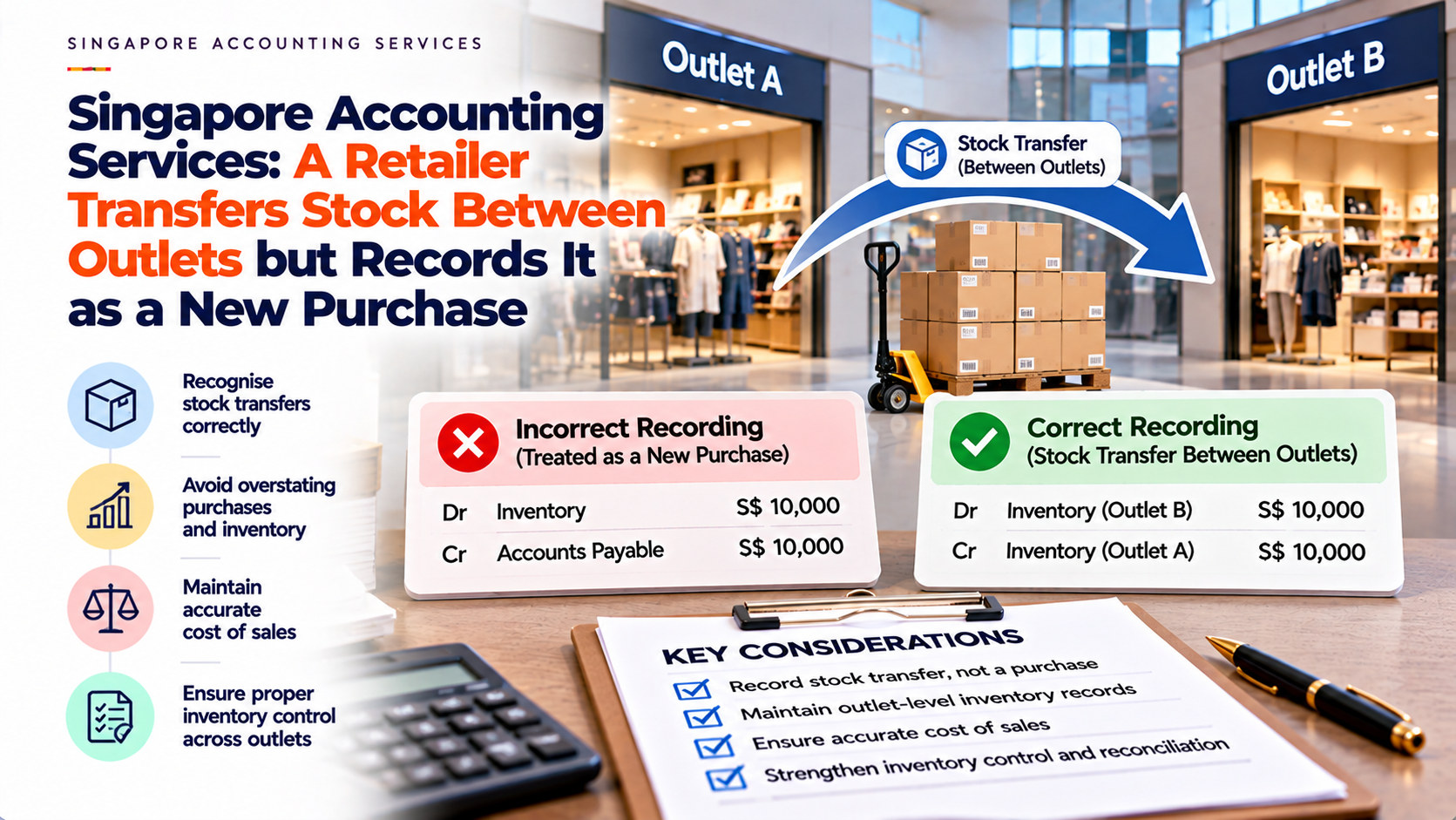
One outlet is running low on a popular product while another has more stock than it needs. The store managers arrange a transfer, the goods arrive and the receiving team enters them into its inventory system. Because the system asks for a supplier document, someone records the delivery as a new purchase.
The shelves now show the correct products, but the accounting records may tell a different story. The original outlet might still show the stock, the receiving outlet may have created an additional inventory balance and finance may see a payable that nobody actually owes. A routine operational movement has become a reporting problem.
For retailers considering Singapore accounting services, stock transfers are an important connection between store operations and financial records. Lee & Hew provides accounting and bookkeeping services through Audit Services Singapore. Reviewing how transfers enter the accounts can help management identify why inventory, purchasing reports and outlet margins no longer agree.
Establish Whether the Outlets Belong to the Same Company
Before deciding how a transfer should be recorded, confirm the legal entities involved. Two outlets operating under the same retail brand may belong to one company, separate group companies or independent franchisees. Their signage does not establish the accounting relationship.
This article focuses on transfers between outlets of the same company, where the company continues to own the goods. Such a movement changes the stock’s location without creating a new external purchase or a sale to a customer.
Transfers between separate companies need a different assessment, including the applicable transaction, invoicing and reporting requirements. Finance should maintain an outlet list showing the operating entity so that staff do not apply one process to arrangements with different legal and accounting consequences.
Trace How the Incorrect Purchase Was Created
The error often begins with a practical workaround. Staff need to increase the receiving outlet’s stock quantity, but they cannot find a transfer function or do not have permission to use it. A purchase receipt appears to achieve the immediate operational result.
In another system, the store correctly records a transfer, but an integration sends every goods receipt to the accounting software as a supplier purchase. The problem then sits in the mapping between systems rather than in the store’s actions.
Trace an affected transaction from the dispatch document through the receiving record and into the general ledger. Identify which step created the additional purchase and whether the same process applies across all outlets. Correcting an individual entry will have limited value if the system continues generating the same error.
Follow Both Sides of the Stock Movement
A valid transfer needs a corresponding reduction at the dispatching location and an increase at the receiving location. The records should identify the same goods, quantities and transfer reference. Any difference needs an explanation.
Consider a hypothetical retailer with 100 units at Outlet A, each carrying a cost of S$40. It moves 30 units to Outlet B. Assuming no other movements or additional costs, Outlet A should show 70 units worth S$2,800 and Outlet B should show 30 units worth S$1,200.
The company still holds 100 units with a combined carrying amount of S$4,000. If Outlet A retains all 100 units while Outlet B records a new purchase of 30 units, the records instead show 130 units worth S$5,200. The additional S$1,200 has arisen from duplicate recording rather than another acquisition.
Check the Other Side of the Accounting Entry
An inflated inventory balance is only part of the investigation. Finance also needs to identify what the system credited when it created the supposed purchase. The entry might have created accounts payable, used a clearing account or affected another balance.
If the system created a payable to an actual supplier, that amount may enter the payment proposal despite there being no new supplier invoice. If it used a dummy supplier account, the balance may remain unresolved and grow with every transfer.
Review the full posting rather than removing only the excess quantity. The financial correction needs to address every affected account. Otherwise, the stock report may look correct while a false liability or unexplained clearing balance remains in the accounts.
Understand Why Profit May Be Affected Differently
The effect on profit depends on the inventory system and the entries made. A duplicate inventory receipt with a corresponding payable may initially overstate assets and liabilities without changing profit immediately. Later sales, costing calculations or stock adjustments can then affect expenses and margins.
Under a periodic inventory process, an incorrect purchase entry may affect the purchases figure used in calculating cost of sales. A subsequent physical count or closing-stock adjustment can create a different result. Finance should therefore establish the actual posting sequence before explaining the impact to management.
Avoid assuming that every duplicate transfer causes the same profit error. Quantify the affected inventory, liabilities and income-statement accounts using the company’s records. That analysis provides a sound basis for corrections and explains why outlet reports may have changed unexpectedly.
Preserve the Appropriate Inventory Cost
Moving goods between outlets should not automatically reset their cost to the retail selling price or an internal transfer price. The accounting records need to preserve a supportable carrying amount under the company’s inventory policy.
IAS 2 requires inventory to be measured at the lower of cost and net realisable value. Its cost guidance includes purchase costs and other qualifying expenditure incurred in bringing inventory to its present location and condition. A transfer document alone does not create a second purchase cost.
Review how the inventory system carries cost between locations, particularly where outlets maintain separate average-cost calculations. Any actual transport or handling expenditure requires its own assessment under the applicable policy. It should not be added automatically merely because stock moved between stores.
Separate Internal Performance Measures From Company Revenue
Some retailers use internal transfer prices to evaluate outlet performance. The sending store may receive an internal credit, while the receiving store bears an internal charge. Such measures can support management reporting when clearly defined.
However, internal charges between outlets of the same company do not represent sales to external customers. They need to be identified and reconciled so that company-wide revenue and costs are not inflated by movements within the business.
Management should understand whether an outlet’s reported margin includes these internal charges and how they are removed or reconciled at company level. Otherwise, an outlet may appear to generate revenue simply by transferring goods, while another appears less profitable because it received stock at an internal markup.
Control Transfers That Cross Month-End
Stock may leave one outlet on the last day of a month and reach the other outlet several days later. If the dispatching outlet removes it immediately and the receiving outlet records it only on arrival, the goods can temporarily disappear from the combined stock report.
The opposite can also happen. The receiving outlet may record an expected delivery before the dispatching outlet processes its transfer, leaving the goods counted twice. Finance needs a consistent way to identify stock moving between locations.
Use a supported stock-in-transit record or an equivalent system process. At month-end, reconcile dispatches awaiting receipt and investigate old outstanding items. Goods still owned by the company need to remain accounted for even while their physical location changes.
Match Quantities, Product Codes and Units of Measure
Matching total values will not identify every transfer error. One outlet may dispatch cartons while another records individual units. Different product codes for the same item can also create apparent shortages in one record and excess stock in another.
The transfer document should specify the product, quantity and unit of measure clearly. Where batches, serial numbers or expiry dates matter, include those details so that the receiving outlet can confirm the actual goods received.
Record discrepancies when the delivery arrives. If 30 units were dispatched but only 28 arrived, investigate the missing two rather than marking the entire transfer complete. Finance should distinguish an administrative mismatch from an actual loss or damage event before posting an adjustment.
Reconcile Store Records With the General Ledger
The point-of-sale system, stock system and accounting ledger may each produce a different total. Reconciliation requires an understanding of what each report includes and when transactions are transferred between systems.
Compare opening inventory, external purchases, customer sales, returns, internal movements and other adjustments. Within the same company, the net quantity effect of a completed transfer should reconcile across the locations. Explain any remaining differences by transaction rather than using a broad balancing entry.
Lee & Hew’s accounting and bookkeeping services are relevant to reviewing these connections between operational records and financial reporting. For a retailer using Singapore accounting services, useful support begins with access to the underlying movement reports and posting rules, rather than only the final inventory total.
Correct Historical Errors With an Audit Trail
If duplicate transfers have accumulated, first identify the affected period, outlets and transaction types. Preserve the original records and supporting documents before making changes. This allows finance to explain what was wrong and how each correction was determined.
Consider subsequent activity before reversing an entry. Some incorrectly recorded units may already have been sold, returned or adjusted through a stock count. Reversing the original purchase without examining those movements could create negative quantities or another costing error.
Prepare a correction schedule covering both inventory and financial balances. Obtain the appropriate review and assess whether previously issued reports require further consideration under the applicable framework. The objective is a traceable correction that restores consistency across systems.
Make the Correct Process Easier to Follow
A reliable process should give store staff a clear method for dispatching and receiving transfers. Staff should not need to invent supplier invoices or use expense adjustments to move stock into the right location.
Assign responsibilities for initiating, approving and confirming transfers. Use a unique reference that follows the movement through both outlets and the accounting records. Configure access so that staff can perform the required task while unusual adjustments receive appropriate review.
Test the process with realistic cases, including partial deliveries, rejected transfers and month-end movements. Training should explain why the distinction matters: the company is tracking existing goods, and an incorrect purchase entry can affect liabilities, margins and future purchasing decisions.
Use Exception Reports to Find Recurring Problems
Routine review can identify patterns before they become large year-end differences. Useful exceptions include unmatched dispatches, receipts without transfer references and transfer documents posted to purchase accounts. Negative stock and unexplained supplier balances can also indicate a process requiring investigation.
Assign each exception to someone who can resolve it and set an expected completion date. Repeated entries from the same outlet may indicate a training issue, while errors across all stores may point to system configuration.
Use the findings to improve the underlying process. Repeatedly correcting the same type of transaction through manual journals leaves operational reports unreliable and makes the finance team responsible for repairing errors that could be prevented earlier.
Keep Stock Movements Connected to Reliable Accounts
A retailer should be able to move products between outlets without creating inventory it does not own or debts it does not owe. Achieving that requires matched dispatch and receipt records, consistent costing and a clear distinction between internal transfers and external purchases.
Management benefits from more than a cleaner stock report. Reliable transfer records support purchasing decisions, outlet performance comparisons and supplier payment controls. They also make physical stock differences easier to investigate because administrative errors are less likely to obscure genuine losses.
For retailers considering Singapore accounting services, Lee & Hew can discuss the accounting and bookkeeping processes behind these records. Bring examples of transfer documents, inventory reports and related ledger entries so that the source of the differences can be reviewed and a more consistent reporting process established.