
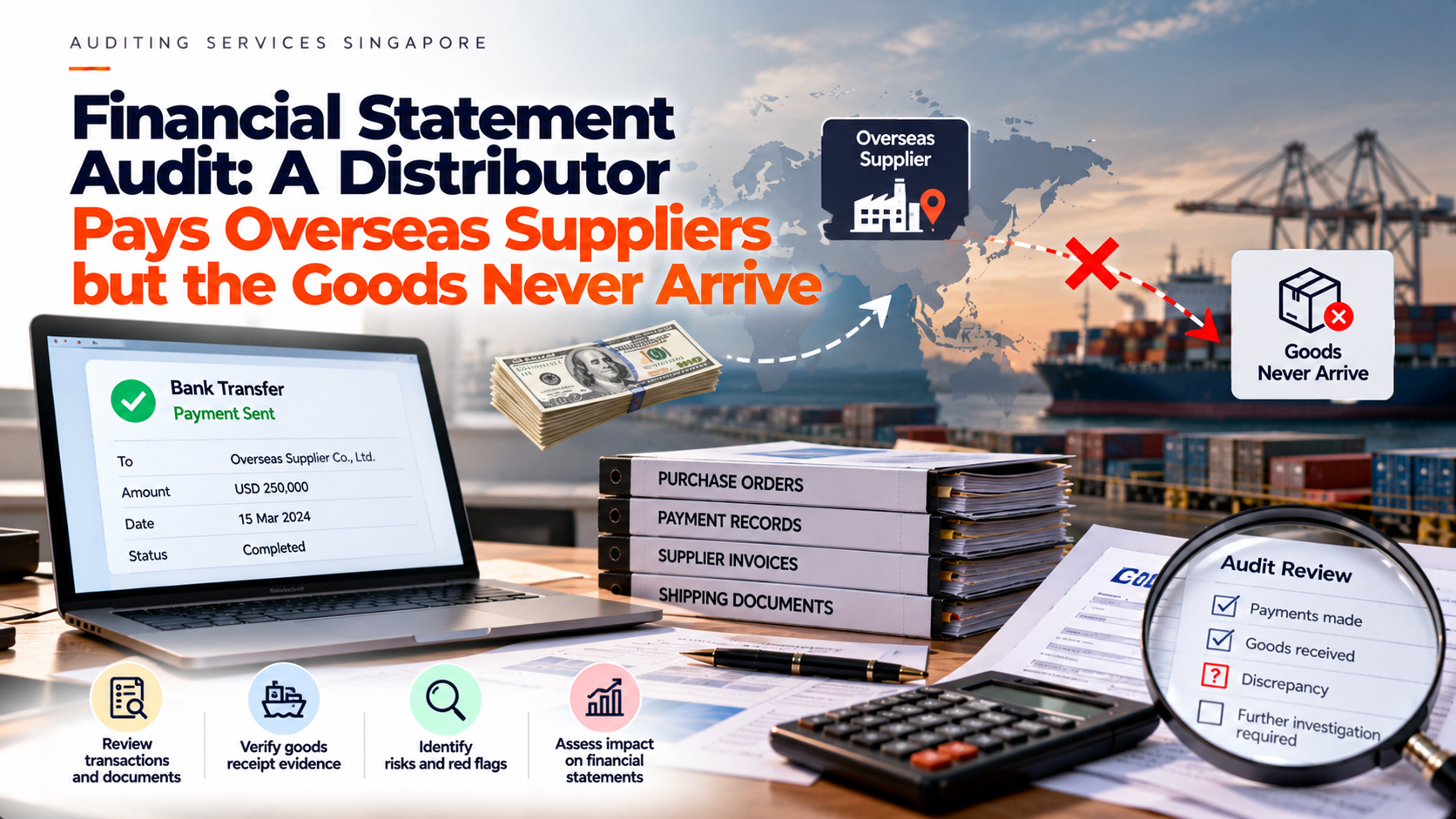
A distributor pays an overseas supplier to secure stock for an important sales period. The supplier confirms the order, receives the advance and promises shipment within several weeks. Then the delivery date changes. Shipping documents remain unavailable, responses become less specific, and the goods still have not arrived when the financial year ends.
The payment remains in the accounts as a supplier advance. However, its continued presence on the balance sheet raises a question: what evidence supports the amount the company expects to recover through goods or a refund?
Lee & Hew provides financial statement audit services through Audit Services Singapore. For distributors facing delayed or failed overseas purchases, preparing for the audit means establishing the transaction’s status, documenting the rights involved and assessing whether the recorded balance remains supportable. Proof that money left the bank is an important starting point, but it does not resolve those questions.
Establish What Happened to the Order
A missed delivery date can arise from production delays, freight disruption, documentation problems or more serious difficulties at the supplier. Management needs to distinguish these possibilities before deciding how to treat the balance.
Prepare a timeline covering the purchase agreement, payment, original delivery commitment and subsequent changes. Include correspondence explaining the delays and identify which statements have been independently supported.
A supplier’s message that goods are “being arranged” provides less information than a verifiable production update or shipment record. Repeated assurances should be assessed alongside the supplier’s actions and the time elapsed.
The timeline should also record the distributor’s response. Has it accepted a revised delivery date, cancelled the order, requested repayment or instructed advisers? These developments can affect the rights and evidence relevant to the accounting assessment.
Distinguish an Advance From Goods Already Acquired
Goods not yet received at the warehouse are not necessarily goods the distributor has not acquired. Some shipments may be in transit, with the relevant rights and risks determined by the contract and actual circumstances.
Review the purchase terms, transport documents and evidence of shipment. Establish whether the goods exist, whether they relate to the company’s order and what the contractual arrangements say about delivery and ownership.
An invoice or payment receipt alone does not establish that inventory should be recorded. Equally, the absence of a warehouse receipt does not automatically mean the amount must remain a supplier advance.
Management should document the basis for its conclusion. The financial statement audit will consider the substance of the transaction and supporting evidence, rather than rely solely on the description selected in the accounting system.
Reconcile the Outstanding Amount Before Assessing Recovery
Before evaluating the risk of loss, confirm how much remains outstanding. Supplier accounts can contain several orders, partial deliveries, credit notes and payments that have not been allocated correctly.
Prepare an order-level reconciliation linking each payment to the relevant purchase commitment. Deduct amounts properly applied to goods received or refunds, and explain differences between the supplier’s statement and the company’s ledger.
Consider a hypothetical distributor that paid S$180,000 equivalent across three orders. Two orders were delivered and correctly accounted for, using S$110,000 of the advances. The remaining exposure is S$70,000, not the original S$180,000 payment total.
A reliable breakdown allows management to focus on the unresolved order. It also prevents goods already received from being counted twice or a refund from being overlooked when assessing the remaining balance.
Identify Whether the Company Expects Goods or Cash
The nature of the company’s right matters. A prepayment whose benefit is the receipt of goods or services is generally not a financial asset merely because it appears under a heading such as “other receivables.”
If the order has been cancelled and an enforceable right to a cash refund has arisen, the analysis may change. Management should establish what the agreement permits, what the parties have agreed and whether the supplier disputes the obligation.
Renaming a ledger account does not create a refund right. A request for repayment also does not necessarily mean the supplier has accepted cancellation or that the contractual conditions for repayment have been met.
Where the position is unclear, appropriate legal advice can help establish the rights involved. Finance can then assess classification and measurement under the applicable reporting requirements, rather than applying the same treatment to every outstanding supplier balance.
Assess the Evidence Supporting Recovery
Once the outstanding amount and contractual position are clear, assess what supports recovery. The evidence may relate to the supplier’s ability to deliver goods, repay cash or fulfil an agreed settlement.
Relevant information could include verifiable shipment records, reliable financial information, actual partial refunds or a credible delivery plan supported by operational evidence. Management should also consider information that contradicts its expectations.
Repeated broken commitments, an inability to contact the supplier or reports that production has stopped may warrant closer investigation. None should be dismissed solely because the company has worked with the supplier for several years.
The assessment should explain why the evidence supports the amount retained in the accounts. A long-standing relationship can provide context, but it does not replace current information about the unresolved transaction.
Do Not Apply a Single Impairment Method to Every Balance
The appropriate impairment requirements depend on the asset’s nature. A non-financial prepayment and a contractual cash receivable do not automatically fall under the same model.
For assets within IAS 36, the carrying amount is assessed against recoverable amount. Financial assets within the relevant IFRS 9 requirements instead require consideration of expected credit losses. Management should first establish which requirements apply to the balance.
A company should therefore avoid using a generic receivables percentage without considering the contractual rights and specific evidence. It should also avoid assuming that every delayed order must be written off in full.
For illustration, if an appropriately prepared assessment supports only S$25,000 of a S$70,000 carrying amount, the resulting S$45,000 reduction needs to be reflected under the applicable requirements. The S$25,000 must have a defensible basis, rather than being selected to limit the effect on profit.
Treat Refund Promises With Appropriate Scrutiny
A supplier may acknowledge the problem and propose repayment by instalments. That can be useful evidence, but the promise should be considered alongside the supplier’s capacity and actual performance.
Review whether the proposed schedule is documented, whether payments have begun and whether earlier commitments were honoured. A settlement plan that repeatedly changes may provide limited support for the original carrying amount.
A small initial refund does not necessarily demonstrate that the entire remaining amount will be recovered. Management should assess the whole arrangement, including the timing and uncertainty of future receipts.
The same principle applies to an offer of replacement goods. Confirm whether those goods are available, suitable for the distributor’s business and consistent with the agreed settlement. Accepting unwanted or obsolete products may not restore the economic value originally expected.
Review Information Received After Year-End
The supplier may deliver goods, repay part of the advance or enter formal insolvency proceedings after the reporting date. Such developments need to be evaluated before the financial statements are authorised.
Under IAS 10, information that provides evidence of conditions existing at the reporting date can require adjustment. Events reflecting new conditions arising afterwards are treated differently, with disclosure required where material.
For example, later information about financial difficulties already affecting the supplier at year-end may be relevant to the earlier assessment. A new event occurring after year-end requires a separate analysis.
Maintain a dated record of subsequent correspondence, deliveries and receipts. This helps management explain what the later information establishes, rather than assuming that every post-year-end event either belongs entirely to the next period or automatically changes the earlier accounts.
Keep Recovery Action Separate From the Accounting Conclusion
Management may continue pursuing a supplier while recognising that the balance requires reduction. An accounting adjustment does not, by itself, mean the company has abandoned its contractual rights.
Similarly, commencing legal action does not establish that recovery is assured. The financial assessment needs to consider the available evidence and uncertainty, even where the company is actively seeking payment.
Keep the recovery file and accounting assessment connected. Updates from advisers, supplier negotiations and actual receipts should reach finance promptly so that the assessment remains current.
Lee & Hew’s financial statement audit services provide an independent assessment of the financial statements. Management remains responsible for pursuing recovery, determining the accounting treatment and supporting its judgments. The audit does not replace commercial follow-up or guarantee reimbursement.
Prepare a Clear File for the Financial Statement Audit
The audit file should allow the transaction to be followed from approval through payment to its current status. Include the purchase agreement, supplier details, bank evidence, correspondence and relevant shipping records.
Add the order reconciliation, management’s recovery assessment and any legal or settlement documents. Where information is missing, identify the gap and explain the steps taken to obtain it.
The auditor may seek direct confirmation or other evidence depending on the circumstances. A supplier’s confirmation that it holds an advance can support the existence of a balance, but it does not necessarily establish that the amount is recoverable.
A concise summary of the issue is useful alongside the detailed documents. It should explain the outstanding amount, relevant dates, rights involved, evidence considered and management’s proposed treatment. This makes the basis of the conclusion easier to assess.
Consider the Effect on Customer Commitments and Cash
The missing goods may affect more than the supplier advance. The distributor may need to purchase replacement stock, revise customer delivery dates or review commitments already made to buyers.
Prepare an updated cash forecast reflecting realistic recovery assumptions and any replacement purchases. Avoid treating the same expected refund as available cash while also assuming it will fund replacement goods that require immediate payment.
Operational decisions need their own review. A second advance to the same supplier should be assessed on current evidence, particularly if the explanation is that additional funds are needed to release the original order.
The accounting review can help make the exposure visible, but management must decide how to protect ongoing operations. Understanding the financial position early gives the business more time to compare alternatives.
Improve the Review of Future Supplier Advances
Once the immediate issue is addressed, examine how it remained unresolved. The company may have approved the payment appropriately but lacked a process for monitoring delivery after the funds were transferred.
Maintain a schedule of advances showing the supplier, order reference, amount, expected delivery date and responsible purchaser. Highlight overdue commitments and record the next action rather than repeatedly moving the expected date forward without explanation.
Finance and purchasing should review significant exceptions together. Purchasing understands the supplier relationship and operational status, while finance can reconcile the exposure and assess the reporting implications.
The controls should reflect the size and risk of the transaction. Clear approval, reliable payment verification and documented follow-up are more useful than treating every advance as a routine ledger balance until year-end.
Support the Balance With More Than an Expectation
An overseas supplier advance remains supportable because of the rights and economic benefits it represents, not simply because the company paid the money and still hopes to receive something in return.
A dependable review establishes the order’s status, reconciles the outstanding amount and evaluates the evidence for delivery or repayment. It also considers later information and records any necessary accounting adjustment without losing track of recovery efforts.
Lee & Hew offers financial statement audit services through Audit Services Singapore. Distributors preparing for an audit can discuss significant supplier advances early and organise the records supporting management’s assessment.
The practical starting point is the list of payments attached to overdue orders. Confirm what has happened, identify what the company can reasonably support and assign responsibility for the next step. That gives directors a clearer view of both the reported asset and the business exposure behind it.