
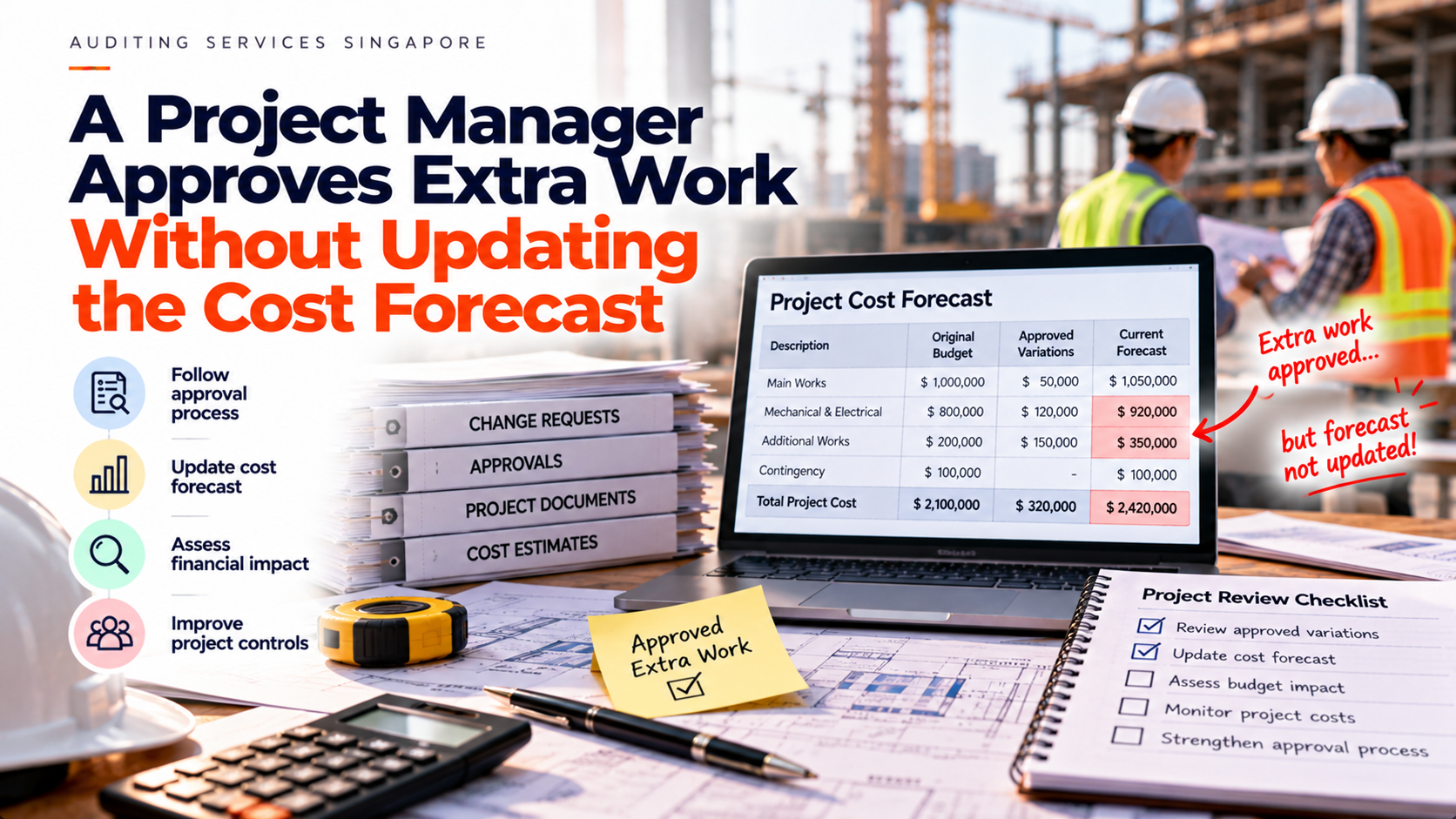
A project is progressing on schedule when the team encounters an unexpected requirement. Additional installation work is needed, a subcontractor must return to site, or the customer requests a change before completion. The project manager authorises the work to keep things moving.
Operations adjusts immediately, but the financial forecast stays unchanged. The purchase order has not been updated, finance has not received an invoice, and management continues reviewing the original projected margin. By the time the extra costs reach the accounts, the opportunity to respond may have narrowed.
Lee & Hew provides accounting and bookkeeping services through Audit Services Singapore. For businesses managing project expenditure, reliable financial information depends on connecting operational decisions with forecasts and accounting records. An approval that changes the expected cost of delivery needs to reach the people reporting on the project, even before payment becomes due.
An Operational Decision Can Change the Financial Outcome
Project managers often make decisions under time pressure. Waiting for a lengthy approval process may delay work, disrupt another contractor or jeopardise a delivery date. A practical response can be necessary.
The difficulty arises when the financial effect remains undocumented. A verbal instruction to continue work can create a commitment that is absent from the report used by management.
The original estimate then becomes less useful as a prediction of the final outcome. It may still provide a benchmark for assessing performance, but it no longer describes what the business expects to spend.
The company needs a process that captures the decision promptly. That process should record what changed, why the additional work was necessary and the expected financial effect, with responsibility assigned for confirming any uncertain amounts.
Separate the Original Budget From the Current Forecast
The original project budget records the assumptions used when the work was approved or priced. The current forecast should reflect the latest information about completing the project.
Keeping both figures allows management to understand how the position has changed. Replacing the original budget with a higher number without explanation can hide the overrun. Leaving the forecast unchanged can hide the expected outcome.
A useful project report shows the original budget, costs incurred to date and the latest estimate of remaining expenditure. It should explain significant changes between reporting periods.
For example, an increase might arise from a customer variation, an estimating error, additional labour or remedial work. These causes require different management responses. The report should make the reason visible rather than combine every movement into a single unexplained variance.
Include Commitments Before the Invoice Arrives
An invoice-based report can lag behind operational reality. A subcontractor may have accepted an instruction and scheduled work while the related invoice remains several weeks away.
The project forecast should capture the expected expenditure associated with that commitment. Waiting for the invoice means management sees the cost only after much of its ability to influence the outcome has passed.
Supporting information can include an approved quotation, a purchase order, written instructions or a documented estimate from the responsible manager. Where the amount is uncertain, record the assumption and identify when it will be confirmed.
This does not mean every commitment becomes an immediate accounting expense or liability. The forecast looks ahead to expected expenditure. The accounting assessment considers what has occurred and the applicable recognition requirements. Both records are needed, but they serve different purposes.
Understand the Difference Between Future Work and Work Already Performed
Finance should establish whether the extra work is merely planned, contractually committed, partly completed or fully delivered. Those stages can lead to different accounting conclusions.
An order for future services ordinarily needs to be considered in the project forecast, while its financial statement treatment requires a separate assessment. An invoice that has not yet arrived does not automatically prevent recognition of a liability for services already received.
At month-end, ask project managers to identify work performed but not yet billed. Review the supporting evidence and determine whether an accrual or another accounting entry is required. The related cost may be an expense or form part of an asset, depending on its nature and the applicable requirements.
Avoid using the forecast as a substitute for this review. A schedule of expected future spending cannot, by itself, establish which amounts belong in the current period’s accounts.
Show How Several Small Changes Affect the Margin
Consider a hypothetical installation project with agreed customer revenue of S$500,000 and an original forecast cost of S$380,000. The expected project margin is S$120,000 before other company overheads.
During delivery, the project manager approves S$18,000 of additional cabling work, S$12,000 of extra labour and S$10,000 of replacement materials. Assume these are additional costs, with no overlap, and the remaining original estimate is otherwise unchanged.
The revised forecast cost becomes S$420,000, reducing the expected margin to S$80,000 if revenue remains S$500,000. The S$40,000 increase has removed one-third of the original projected margin.
Each individual approval might have seemed manageable. The combined effect is more significant. A current forecast helps management see that accumulation while there is still time to review purchasing, scheduling and commercial options.
Do Not Assume the Customer Will Pay for Every Change
Approval to incur a cost is different from customer agreement to pay more. A project manager may authorise additional work for operational reasons while the commercial team is still negotiating the price.
The report should distinguish agreed variations from requests awaiting approval and claims that the customer disputes. An internal expectation of recovery should not be presented as confirmed additional revenue.
Suppose management hopes to recover S$30,000 of the S$40,000 overrun in the example. That possibility is useful for scenario planning, but it should remain clearly identified until the supporting contractual and commercial position is established.
Any accounting recognition of additional revenue requires its own assessment. Keep the customer correspondence, variation terms and basis of calculation available so that finance can evaluate the position rather than simply offsetting extra costs with an optimistic recovery figure.
Review the Remaining Work, Not Only the Latest Addition
Adding the latest approved cost to an old forecast may still leave the estimate incomplete. A change in scope can affect work that has not yet started.
Additional installation may extend equipment hire, require more supervision or alter the sequence of other subcontractors. A delayed task could also affect transport arrangements or staff availability.
The project manager should therefore reassess the cost to complete after a significant change. Identify the direct addition and its practical consequences for the remaining programme.
The review should avoid adding a general contingency on top of costs already included without explanation. Management needs to understand which amounts relate to identified commitments, reasonable estimates and unresolved risks. Clear categories make the forecast easier to challenge and update.
Update the Cash Forecast Alongside the Cost Forecast
A project can retain a positive expected margin while creating an immediate cash problem. Subcontractors may require payment for the extra work before the customer accepts or pays for a variation.
The cash forecast should show the expected payment dates and realistic collection assumptions. It should include deposits, staged payments and any other timing conditions relevant to the additional work.
For example, the business might need to pay S$25,000 next month while the related customer discussion remains unresolved. That cash requirement exists even if management believes the cost will eventually be recovered.
Lee & Hew’s accounting services can support the financial records used in management review. Project teams still need to provide current commitments and scheduling information so that finance can connect expected costs with their likely payment dates.
Set Approval Rules That Consider the Whole Project
An approval limit based only on each individual instruction can miss a growing overrun. Several small authorisations may collectively change the project’s financial position without triggering a higher-level review.
Consider cumulative changes as well as individual amounts. Management may also want escalation when the expected margin falls below a defined level or when unapproved customer variations become significant.
Emergency work needs a practical route. If an urgent instruction is necessary, require a prompt written record and subsequent review rather than allowing the exception to remain outside the process.
The rules should also distinguish additional customer scope from internal rework or estimating errors. A cost incurred to correct the company’s own work raises different commercial questions from a new service requested by the customer.
Maintain a Shared Change Register
A change register can connect operational instructions with the forecast and accounting records. Each item should identify the project, reason for the change, supplier or internal resource, expected cost and approval status.
Where customer recovery is proposed, record that separately. Include the amount requested, the evidence supporting the request and the current status of the discussion.
The register should also identify whether the work has started, whether an invoice has arrived and whether the cost is already included in the latest forecast. These fields help prevent omissions and double counting.
Use a consistent reference across quotations, purchase orders and project reports. A simple register maintained throughout delivery is more useful than reconstructing the history from emails after the project has finished.
Reconcile Actual Costs With Outstanding Commitments
As invoices arrive, the forecast needs to reflect the movement from estimated or committed costs to actual recorded amounts. Otherwise, the same expenditure can appear twice.
For example, a S$12,000 labour commitment should not remain in full as a future cost after the corresponding S$12,000 invoice has been recorded, unless further work is separately expected.
Review partial invoices carefully. A supplier may bill only part of an approved scope, leaving a genuine remaining commitment. The project team should confirm what remains to be delivered rather than finance assuming the first invoice closes the order.
A regular reconciliation between ledger costs, accruals, purchase commitments and the cost-to-complete estimate keeps the report understandable. Each amount should have a clear role in the calculation of the expected final cost.
Escalate Projects That May Become Loss-Making
A deteriorating forecast may require more than a management explanation. Where expected costs suggest that a contract could be onerous, finance should assess the relevant accounting requirements.
IAS 37 requires a provision for an onerous contract, while a general expectation of future operating losses does not itself justify a provision. The assessment requires consideration of the contract’s circumstances and applicable requirements, rather than automatically recording the entire forecast overrun.
Management should involve finance early when the expected economics change materially. Delaying the discussion until project completion can leave both reporting and commercial decisions behind the current facts.
The immediate response should include reviewing the remaining obligations, available alternatives and reliability of the forecast. A loss-making projection is a reason for a supported assessment, not an invitation to insert balancing entries into the accounts.
Close the Project With Its Remaining Costs Visible
Operational completion does not always mean every financial matter is settled. Final subcontractor invoices, agreed variations and remedial commitments may remain outstanding.
Before closing the project report, obtain confirmation of the remaining work and costs. Identify which balances are supported estimates and which matters require further negotiation or investigation.
Compare the final outcome with the original budget and the intervening forecasts. This can reveal whether the main issue was inaccurate estimating, delayed communication or changes that were outside the original scope.
The findings should inform future quotations and approval procedures. Closing a project without understanding the reasons for its margin movement risks repeating the same problem on the next contract.
Connect Decisions With the Reports Used to Manage Them
A project forecast becomes useful when it reflects the decisions already being made on the ground. If extra work is approved but never reaches the report, management is reviewing a version of the project that no longer exists.
The practical response is to capture changes promptly, distinguish costs from possible customer recovery and reconcile actual expenditure with the remaining commitments. Finance should then assess the accounting treatment separately from the operational forecast.
Lee & Hew provides accounting and bookkeeping services through Audit Services Singapore. Businesses reviewing project reporting can discuss the supporting records and reconciliations needed to keep financial information connected with delivery.
A useful starting point is the list of extra work approved since the last forecast. Confirm its cost, delivery status and customer position, then update the expected outcome. That gives management a clearer basis for deciding what to authorise next.