
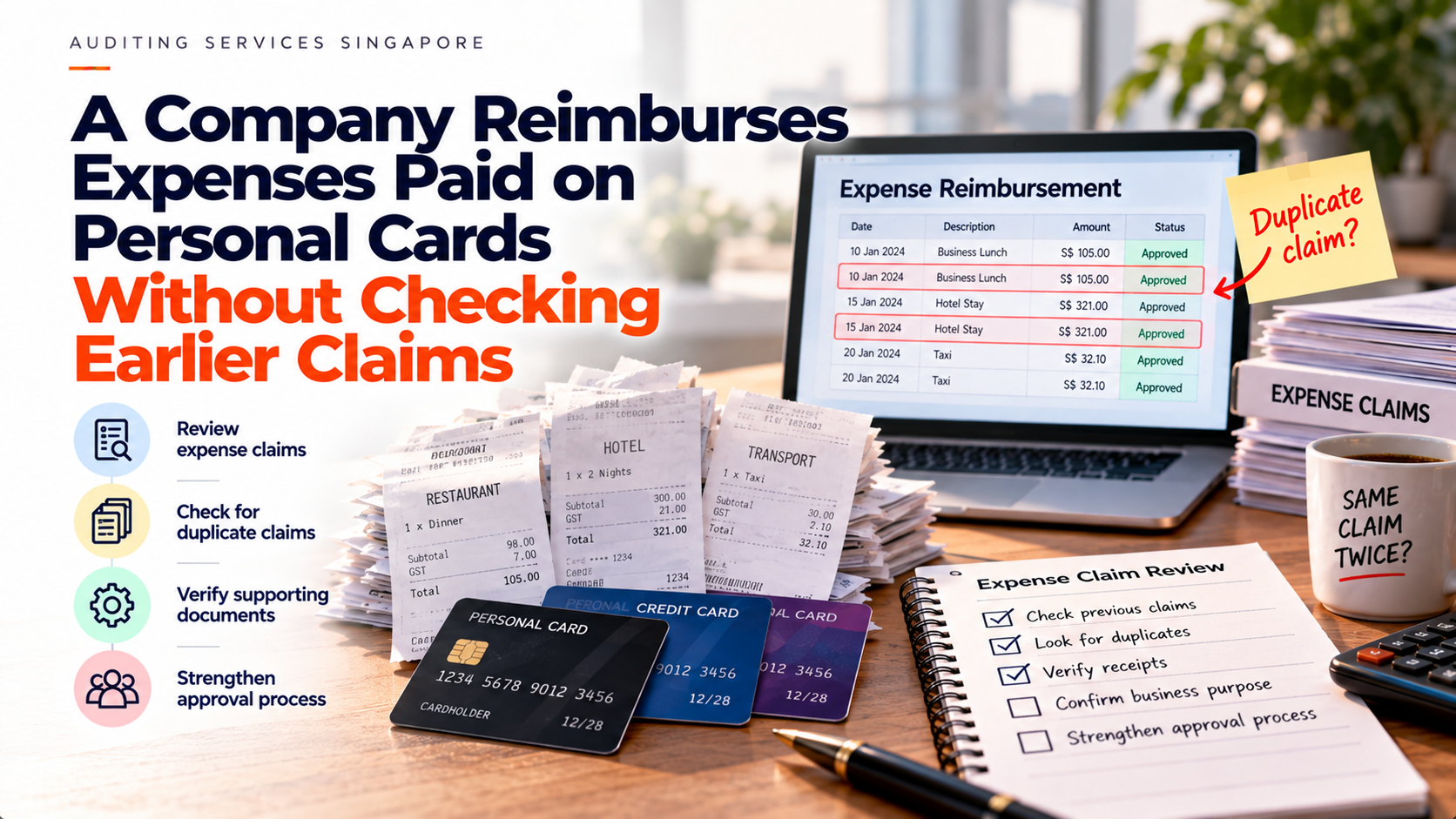
An employee pays for a business purchase using a personal credit card and submits the receipt for reimbursement. The manager approves the expense, finance processes the payment, and the transaction appears complete. Several weeks later, the same purchase appears in another claim, this time supported by a card statement.
Both submissions look reasonable when reviewed separately. Each has evidence of a purchase, a business description and an approval. Without a check against earlier claims, the company can reimburse the same expenditure twice.
Lee & Hew provides accounting, bookkeeping and payroll services through Audit Services Singapore. For businesses processing employee expenses, dependable records need to connect the purchase, approval, accounting entry and payment. A receipt establishes part of that history, but it does not establish whether the employee has already been reimbursed.
Separate a Valid Purchase From a Valid Reimbursement
An expense can be genuinely business-related while the reimbursement request is incorrect. The employee may already have received payment, used a company advance or submitted the purchase through another process.
The review should therefore answer several questions. What was purchased? Why was it needed for the business? Who paid the supplier? Has the company already settled the employee’s entitlement?
These questions serve different purposes. A manager may be well placed to confirm the business reason but have no visibility of earlier reimbursements. Finance may recognise the amount without knowing whether the purchase related to an approved activity.
A complete process brings those checks together. Approval of the business purpose should not be treated as confirmation that the amount remains payable.
Understand How Duplicate Claims Arise
Duplicate reimbursements do not necessarily begin with deliberate misconduct. An employee may resubmit a claim because the first payment was delayed or the system did not show its status clearly.
A purchase might also move through two channels. The employee sends a receipt directly to finance, then includes it in the monthly expense form. A manager requests urgent repayment separately, while the original claim remains in the normal payment queue.
Other duplicates arise when different documents are treated as different purchases. A receipt, supplier invoice, order confirmation and card statement can all relate to the same transaction.
Before drawing conclusions, establish the sequence of submissions and payments. Understanding how the duplicate entered the process helps the company correct the immediate issue and choose a practical control that addresses its cause.
Create One Record for Each Claim
Every claim should have a unique reference that remains attached to its supporting documents, approval and payment. Employees and managers should use that reference when asking about progress rather than submitting the same purchase again.
The record should identify the claimant, supplier, transaction date, currency, amount and business purpose. Where one claim contains several purchases, retain the item-level details needed to check them individually.
A status such as submitted, queried, approved or paid should have a clear meaning. An approved claim is not necessarily a paid claim, and an accounting entry does not necessarily mean the bank transfer succeeded.
This shared visibility reduces uncertainty. If an employee can confirm that a claim is awaiting payment, there is less reason to create another submission simply to prompt a response.
Check More Than the Receipt Number
Matching invoice or receipt numbers is useful, but it will not identify every duplicate. Some receipts have unclear references, and a second submission may use a different document altogether.
Compare the claimant, supplier, purchase date, amount and description with earlier records. Review close matches where differences could arise from rounding, foreign currency conversion or the inclusion of a card fee.
For example, a hotel receipt may show an amount in a foreign currency while the employee’s card statement shows the converted amount in Singapore dollars. Those documents can support one reimbursement rather than two separate expenses.
A potential match is a reason to investigate, not an automatic rejection. Employees can make legitimate repeated purchases for identical amounts. The reviewer should establish whether the documents refer to the same underlying transaction before taking action.
Use a Simple Example to Trace the Problem
Consider a hypothetical employee who pays S$640 for materials needed at a customer event. The employee submits the supplier receipt, receives approval and is reimbursed through a bank transfer.
At month-end, the employee includes the same purchase in a broader claim supported by a personal card statement. The second form describes it as “event supplies” rather than the supplier’s name. Finance approves another S$640 payment because the description does not immediately match the earlier claim.
The company has now paid S$1,280 against one S$640 purchase. The investigation needs to identify both claim references, the accounting entries and the two bank payments.
Correcting only the expense account would leave the cash issue unresolved. Recovering the extra payment without correcting the records could leave the reported cost overstated. Both the payment history and the accounting treatment need attention.
Confirm Who Actually Paid
The supporting documents should establish whether the employee funded the purchase personally. A supplier invoice addressed to the company does not necessarily show how it was paid.
The purchase may already have been settled using a company card, paid directly by accounts payable or covered by another employee. Reimbursement without checking the payment route can create a second payment even when there is only one expense claim.
Where personal card evidence is needed, request the relevant transaction information rather than unrelated personal spending details. The review should obtain sufficient support while handling employee information appropriately.
The company should also distinguish payment evidence from the underlying purchase evidence. A card statement can show that a charge occurred, but it may provide limited information about what was bought or its business purpose.
Bring Advances Into the Same Review
Employees may receive money before a trip, event or purchase. If that advance is not visible when the final expense claim is processed, finance may reimburse the full amount again.
Suppose an employee receives a S$1,000 advance and later submits supported business expenditure of S$1,150. Assuming the expenditure is accepted and there are no other adjustments, the additional amount payable is S$150.
The record should show the advance, the supported expenditure and the resulting balance. If expenditure is less than the advance, the process should identify the amount to be returned or otherwise resolved.
Keeping advances in a separate spreadsheet without connecting them to the claim creates avoidable risk. The reviewer needs a complete view of what the company has already provided before approving further payment.
Define the Responsibilities of Managers and Finance
A manager’s approval should confirm matters within the manager’s knowledge, such as the business purpose, reasonableness and relevant authorisation. Finance should perform the checks needed to establish payment status and record the transaction.
These responsibilities should be explicit. A signature labelled “approved” can otherwise be interpreted differently by everyone involved.
For higher-risk claims, an additional review may be appropriate. Examples include unusual amounts, missing purchase documents or claims submitted long after the transaction. The process should define how exceptions are resolved and who can authorise them.
Lee & Hew’s bookkeeping and accounting services are relevant to maintaining the records behind these checks. The business still needs clear internal approval responsibilities and timely information from employees and managers so that the records can be relied upon.
Record Payments Promptly Across Every Channel
A claim can be paid through payroll, a standalone bank transfer or another approved method. If those payment routes are not connected, one team may process an amount without knowing that another team has already settled it.
Update the claim record promptly with the payment date, reference and amount. Where payroll handles reimbursements, reconcile the relevant payroll output with the expense records.
Failed or returned payments also need clear treatment. A payment instruction should not be marked as successfully settled without appropriate confirmation, while a replacement payment should remain linked to