
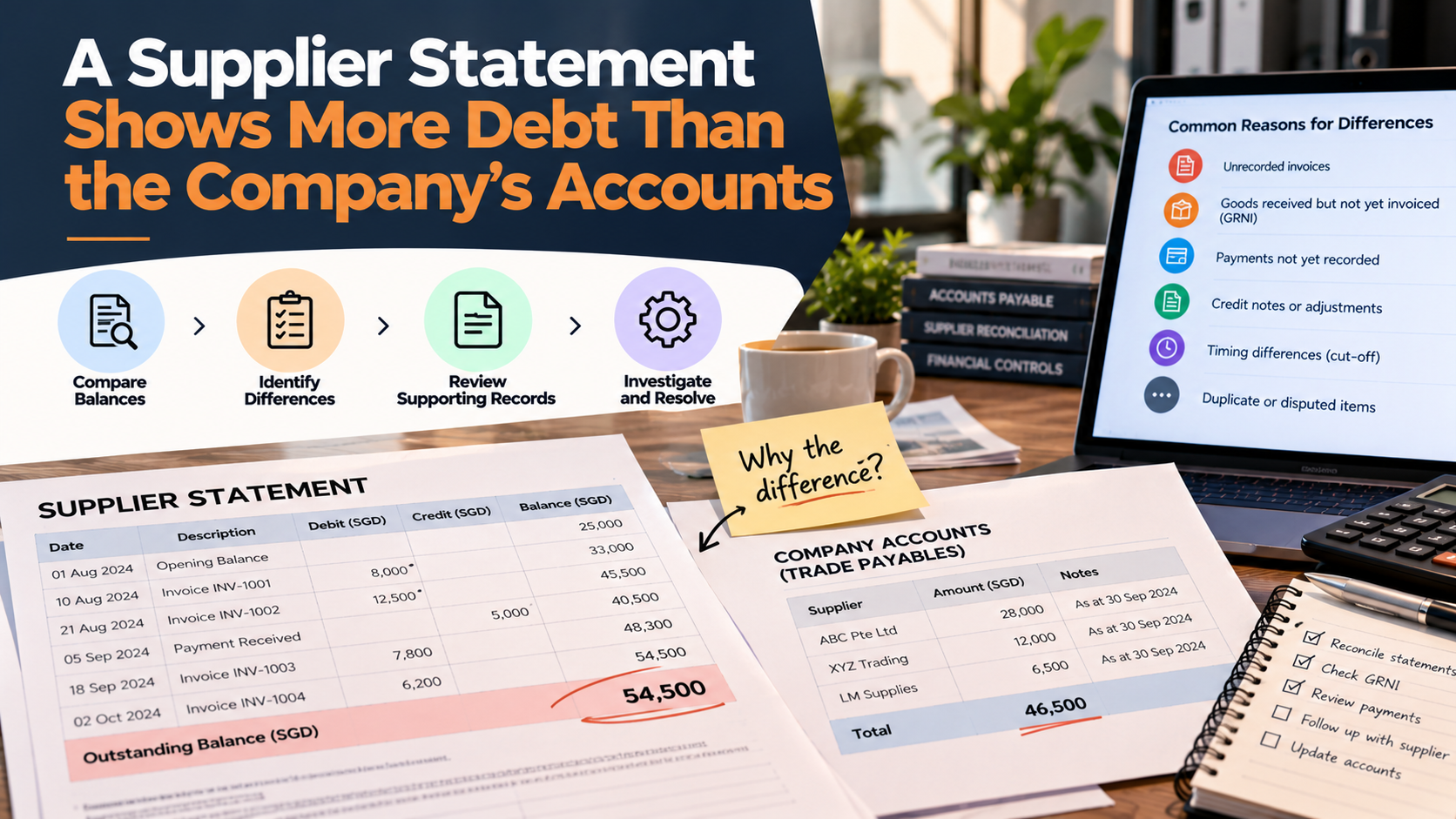
The supplier sends a statement showing S$85,000 outstanding. The company’s accounts show S$62,000. Purchasing says several invoices are still being checked, finance believes a recent payment has already reduced the balance, and the supplier wants settlement before releasing the next delivery.
The immediate temptation is to accept whichever figure appears more convincing. Paying the supplier’s total may seem the quickest way to protect deliveries, while relying on the ledger may feel reasonable because it is the company’s official record. Neither approach explains the S$23,000 difference.
Lee & Hew provides accounting, bookkeeping and financial reporting support through its professional services. For a business facing a supplier discrepancy, the objective is to establish what is genuinely owed, what has already been settled and which items remain unresolved. A clear reconciliation protects both the financial records and the payment decision.
Compare the Same Date, Entity and Currency
Before reviewing individual transactions, confirm that the two balances are comparable. A supplier statement issued today may include invoices or payments that are outside the date of the company’s ledger report. Comparing them without adjusting for timing can create an apparent discrepancy.
Check the legal entity and supplier account as well. A supplier may maintain separate accounts for branches, projects or group companies. The statement could combine balances that the company records separately, or include an invoice addressed to another entity.
Confirm the currency and whether figures include applicable taxes. Where the ledger displays a translated reporting-currency amount, compare the underlying currency balances before investigating exchange differences.
These checks are simple, but they prevent unnecessary work. The reconciliation should begin with two clearly identified balances, prepared on an understood basis, rather than a comparison between unrelated totals.
Obtain the Transaction Detail Behind Both Balances
A statement showing only a balance brought forward is difficult to reconcile. Request the underlying invoices, credits and payment allocations for the relevant period, including older items that remain outstanding.
Export the company’s supplier ledger with transaction dates, invoice references, amounts and payment details. Retain the original reports so later adjustments do not erase the starting point.
Match individual items using references and supporting documents. Similar amounts are not sufficient on their own, particularly where the supplier issues recurring invoices for the same value. A monthly service invoice can easily be matched to the wrong period.
Record unmatched items in a separate schedule. Give each difference a description, amount, responsible person and next action. This turns an unexplained total into a manageable list of questions.
Separate the Causes Instead of Posting One Adjustment
The difference may contain several unrelated issues. A missing invoice, an unapplied payment and a disputed charge require different responses. Posting one expense or payable adjustment for the net difference can hide all three.
Consider a hypothetical reconciliation. The supplier statement shows S$85,000, while the company’s ledger shows S$62,000. Review identifies a valid S$15,000 invoice missing from the ledger, an S$8,000 payment already recorded by the company but not yet allocated by the supplier, and an S$4,000 invoice duplicated by the supplier.
The company has also recorded a valid S$4,000 supplier credit that is absent from the statement. Its adjusted ledger becomes S$77,000 after recording the missing invoice. The supplier’s balance also becomes S$77,000 after deducting the unallocated payment, duplicate invoice and missing credit.
This example is illustrative. It shows why the original S$23,000 difference should not simply be added to the company’s debt. Some corrections belong in the company’s records; others belong in the supplier’s.
Investigate Missing Invoices Beyond the Accounts Inbox
An invoice may have been sent to a project manager, branch administrator or employee who has since left. It may be sitting in an approval queue, rejected by an automated system or attached to a message that never reached finance.
Ask purchasing and operations to confirm whether the goods or services were received. Obtain the order, delivery evidence or service confirmation needed to understand the transaction. A supplier’s statement is a useful starting point, but the underlying invoice and performance evidence remain important.
Determine the appropriate reporting period. Work received before month-end does not necessarily belong to the next month merely because the invoice arrived late. Finance may need to recognise an accrual where the facts support an obligation, then match the eventual invoice against it.
Do not confuse payment approval with accounting recognition. An invoice awaiting an internal signature may still relate to a genuine obligation. Conversely, a claim should not be accepted solely because it appears on the statement.
Trace Payments to the Supplier’s Allocation
A payment can leave the company’s bank account without being matched correctly in the supplier’s records. The remittance advice may be missing, the reference may be incomplete or the supplier may have applied the money to a different invoice.
Obtain bank evidence showing the payment status and beneficiary details. A payment instruction prepared in the banking system is not the same as a completed transfer. Check for rejected or returned payments where relevant.
Send the supplier a clear allocation request supported by the remittance details. Ask for an updated statement or written confirmation showing how the receipt has been applied. Keep that response with the reconciliation.
Avoid paying the same invoice again simply because it remains on the statement. Equally, do not assume the supplier has received the money until the payment trail has been checked. The objective is to establish settlement, not merely to show that someone intended to pay.
Verify Credit Notes and Goods Returns
A return to the supplier may not yet have produced an agreed credit. The supplier could be inspecting the goods, disputing the quantity or applying conditions under the purchase agreement.
Distinguish an issued credit note from an expected claim. Retain the return documentation, supplier acknowledgement and any agreement about the amount. Finance should understand whether the company’s recorded adjustment is supported or still under assessment.
The reverse can also occur: the supplier has issued a credit that the company has not recorded. Review statements and correspondence for credits relating to pricing errors, rebates or earlier returns.
Ensure the same adjustment is not counted twice. A credit might already have been deducted from a later invoice or applied against a payment. Reviewing the transaction chain prevents a second reduction in the payable.
Review Duplicate and Misallocated Invoices
Duplicate entries can occur when an invoice arrives through several channels or when a reminder is mistaken for a new bill. Slight differences in invoice formatting may prevent a system from recognising that the reference already exists.
Compare the supplier, invoice number, date, amount and underlying goods or services. Where a duplicate is identified, retain evidence of the correction rather than deleting the history without explanation.
Check for invoices assigned to the wrong supplier account, branch or group entity. An incorrectly coded bill may explain why one balance is understated while another is overstated. Correcting only the account under review leaves the wider records inaccurate.
This is particularly important where several entities purchase from the same supplier. The fact that the group owes an amount does not establish which company has the obligation or which company should make the payment.
Keep Disputed Charges Visible
A disagreement about quantity, quality, pricing or scope should be documented separately from routine timing differences. Record the supplier’s claim, the company’s position and the evidence supporting each.
Do not remove a disputed invoice merely because management intends to challenge it. The accounting treatment requires assessment of the underlying obligation and available information. A dispute does not automatically establish that nothing is owed.
Likewise, recording a balance for accounting purposes does not necessarily mean management has accepted every commercial term asserted by the supplier. Finance, purchasing and the relevant decision-maker should coordinate their review.
Assign a person with authority to resolve the issue. A recurring note saying “under discussion” is not a resolution plan. Material or complex disputes may require appropriate professional advice before settlement or adjustment.
Approve Payment From the Reconciled Position
Once differences are understood, prepare a proposed payment list identifying the invoices being settled, amounts already paid and items remaining unresolved. The approver should be able to follow the calculation without reconstructing the entire supplier account.
Where commercially and contractually appropriate, paying agreed amounts while separately addressing disputes may help maintain the relationship. Communicate the allocation clearly so the supplier does not treat the payment as an unexplained lump sum.
Verify payment details through the company’s established controls. A statement reconciliation should not become an opportunity to bypass review of a new bank account or an unusual payment request.
Keep the settlement decision distinct from the ledger correction. The records need to reflect the supported obligation, while payment timing depends on the agreed terms and the company’s authorised arrangements.
Reflect the Difference in Financial Reports and Cash Forecasts
A missing liability can make working capital and profitability appear stronger than they are. Depending on the nature of the transaction, correcting it may affect an expense, inventory, a fixed asset or another balance.
Management should receive an explanation of material adjustments rather than only an updated total. Identify which period and activity were affected and whether similar omissions may exist elsewhere.
Update the cash forecast once the expected settlement becomes clearer. A previously unrecorded payment requirement may reduce funds available for payroll, other suppliers or planned purchases. Conversely, resolving an unapplied payment may show that the apparent cash demand was overstated.
Lee & Hew’s accounting and bookkeeping support connects these reconciliations with reliable financial reporting. The value lies in showing management what changed, why it changed and how it affects the business’s next decisions.
Extend the Review Beyond Suppliers Who Send Statements
Supplier statements are useful, but their absence does not establish that the ledger is complete. Some suppliers send only invoices, while others issue statements irregularly or stop sending them when contact details change.
Review goods received but not invoiced, outstanding purchase records and payments made after the reporting date. These can identify obligations that have not entered the ordinary invoice process.
Consider suppliers with little or no ledger balance despite substantial recent activity. A reconciliation programme focused only on the largest recorded creditors may overlook amounts missing from the accounts entirely.
Use a risk-based review schedule that reflects transaction volume, complexity and previous differences. The purpose is to maintain complete records rather than depend on supplier reminders to reveal omissions.
Make Reconciliation a Repeatable Control
Recurring discrepancies often point to a process issue. Invoices may be reaching finance late, remittance advice may not be sent consistently, or goods returns may lack a clear owner.
Agree a regular reconciliation process for significant suppliers. Set deadlines for preparing the schedule, investigating exceptions and obtaining review. Preserve unresolved items between periods so they do not disappear when a new statement arrives.
Define the responsibilities of finance, purchasing and operations. Finance can reconcile the ledger, but the team receiving the goods must confirm what arrived. The person negotiating a credit should communicate the outcome promptly.
ACRA’s financial reporting guidance emphasises complete and accurate records and directors’ continuing responsibility for the financial statements. A practical reconciliation process supports that responsibility by making material liabilities explainable.
Retain the Evidence for Review
Keep the original supplier statement, company ledger, reconciliation and supporting documents together. Record adjustments made by each party and retain the updated position once confirmed.
Where the financial statements are audited, this file can help explain the balance and management’s treatment of significant differences. It does not replace the auditor’s own procedures, but it provides a clearer starting point.
Avoid treating a signed reconciliation as proof that every issue is resolved. Reviewers should distinguish fully supported items from amounts awaiting evidence or management decisions. The status should be accurate, even where the remaining uncertainty is inconvenient.
A well-maintained record also protects continuity. Another team member should be able to pick up the account without asking the original preparer to remember months of conversations.
Resolve the Difference Before It Becomes Routine
A supplier statement showing more debt than the accounts is a reason to investigate. It may reveal missing liabilities, unapplied payments, duplicate bills or unresolved commercial issues. The correct response depends on the evidence behind each difference.
Establish a common reporting date, reconcile transactions and assign responsibility for outstanding matters. Correct the records where necessary, communicate clearly with the supplier and approve payments from a supported position.
Speak with Lee & Hew through Audit Services Singapore about its accounting, bookkeeping and financial reporting support. Consistent supplier reconciliations help the business understand what it owes, avoid unnecessary payments and plan cash using more reliable figures.