
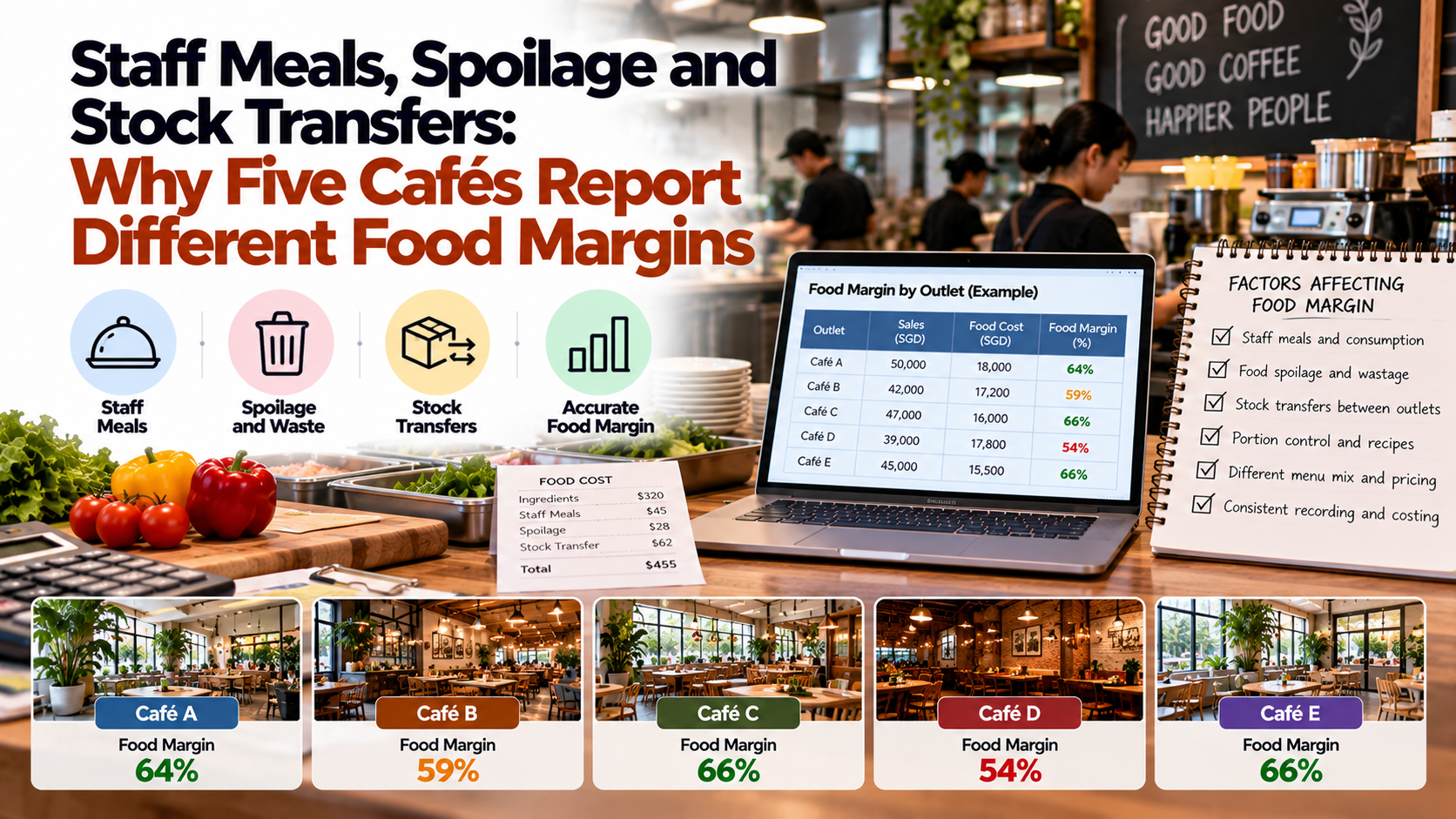
Staff Meals, Spoilage and Stock Transfers: Why Five Cafés Report Different Food Margins
The monthly outlet reports arrive, and one café appears to outperform the others by a comfortable margin. Its food costs are lower, its sales are healthy, and the owner wants the other managers to follow its example. Another outlet looks expensive to operate despite serving a similar menu.
Before changing purchasing targets or questioning the managers, it is worth checking whether the reports measure the same thing. One café may include staff meals in food costs, another may charge them to staff welfare, and a third may leave discarded ingredients in its closing stock. Transfers between locations can create further differences.
Lee & Hew provides accounting, bookkeeping and management accounts services. For a café business, useful reporting depends on connecting those financial records with the everyday movement of ingredients. The numbers should help management distinguish an operating problem from a recording difference.
This article follows five illustrative cafés within one company. They are not a Lee & Hew client case. Their different practices show how apparently simple food-margin comparisons can lead to the wrong conclusion.
Five Cafés, Five Different Recording Habits
Imagine a business with five cafés serving broadly similar food. Each manager submits a monthly sales report, supplier invoices and a closing stock count. Head office combines the figures into a standard spreadsheet.
Café A records staff meals separately from customer food costs. Café B leaves them within general ingredient consumption. Café C records spoilage only when the owner approves a monthly adjustment. Café D regularly sends ingredients to neighbouring outlets but does not record the transfers consistently. Café E records supplier invoices according to the date received, even when the ingredients arrived earlier.
Each manager may believe the report is complete. However, the resulting margins reflect different definitions and cut-off practices. Ranking the outlets before resolving those differences could reward incomplete recording and penalise a manager who reports costs carefully.
The first task is to establish a common basis. Only then can the business investigate genuine differences in purchasing, waste, pricing and menu performance.
Define the Margin Before Comparing It
“Food margin” can mean different things. It might refer to food sales less all ingredient consumption, or to food sales less ingredients attributable to customer dishes, with staff meals and waste shown separately.
Either management view can provide useful information if its purpose and components are clear. Problems arise when the same label is used for different calculations across outlets.
Define the sales base as well. If the numerator contains only food costs but the denominator includes coffee, bottled drinks and other revenue, a café with stronger beverage sales may appear to have a better food margin for reasons unrelated to food preparation.
Use consistent treatment of discounts, refunds and taxes collected. A comparison based on net food sales is easier to interpret when the corresponding costs relate to the same products and period.
The report should show exactly what remains after each cost category. A percentage without a definition can create more argument than insight.
Staff Meals Change Classification, Not the Cost to the Business
Ingredients used for staff meals have still been consumed, even though they do not generate a customer sale. The records need to reflect that stock movement.
For internal reporting, management may choose to identify staff meals separately so that customer food usage can be reviewed more clearly. That requires a practical record of meals provided and a consistent costing method.
Suppose two cafés each consume S$1,000 of ingredients for staff meals. If one includes the amount in food costs and the other reports it under staff welfare, their food margins differ despite identical underlying expenditure.
Moving the amount between categories does not improve the business’s total profit. It changes the presentation. Any management subtotal excluding staff meals should therefore be accompanied by a view that includes them in the outlet’s overall costs.
Staff meals should also be measured at the relevant cost for this analysis, rather than automatically using the menu selling price. Mixing those values would create another inconsistency.
Spoilage Needs a Record When It Happens
Discarded milk, damaged produce and unsold prepared food are easy to overlook during a busy service. If staff remove them physically without recording the movement, the accounting system may still show stock that no longer exists.
Under ordinary inventory accounting requirements, inventory losses are recognised as expenses in the period they occur. Leaving discarded items in closing stock can overstate assets and reported profit.
Use a simple waste record showing the item, quantity, date and reason. The process should make accurate reporting easier, rather than encourage staff to conceal losses to protect a target.
Separate unusual incidents from expected preparation losses where that distinction helps management. A refrigerator failure needs a different response from repeated overproduction of a particular sandwich. Both cost money, but the operational causes differ.
The goal is to make the loss visible soon enough to act. Waiting for a large year-end adjustment makes it harder to identify the event and prevent it from recurring.
A Small Classification Difference Can Change the Ranking
Consider a simplified month in which Café A and Café B each report S$60,000 of net food sales. Each uses S$18,000 of ingredients in customer dishes, S$1,000 for staff meals and S$2,000 through spoilage.
Café A includes all S$21,000 in its food-cost figure. It therefore reports S$39,000 remaining, equivalent to a 65% margin before labour and other operating costs.
Café B reports only the S$18,000 used in customer dishes as food cost. It shows S$42,000 remaining, or 70%, while recording staff meals and spoilage separately elsewhere in the outlet report.
Both cafés have the same S$39,000 remaining after all three ingredient-related categories. Café B’s headline percentage is higher because of presentation, not stronger performance.
If Café C instead leaves S$2,000 of discarded stock in its closing inventory, the problem is more serious. Its profit is overstated by S$2,000 under these assumptions. That requires a correction, rather than simply relabelling a subtotal.
These hypothetical figures exclude taxes, labour and other costs. They show why management needs to distinguish inconsistent presentation from an actual omission.
Stock Transfers Need Matching Entries at Both Outlets
A transfer can make one café appear wasteful and another unusually efficient. Suppose Café D sends ingredients costing S$1,500 to Café E before month-end.
If D’s closing count excludes those ingredients but no transfer is recorded, a consumption calculation may treat the S$1,500 as food used at D. If E then uses the ingredients without recording the receipt, its food cost may be understated.
Create one transfer reference that both outlets acknowledge. Record the product, quantity, cost basis and dispatch and receipt dates. The sending and receiving entries should agree.
For the illustrative outlets within one company, the transfer does not create an external sale or new group profit. It moves stock between locations. Where outlets are separate legal entities, intercompany accounting and tax considerations need their own assessment.
Transfers around month-end also require coordination. Goods should not disappear from the combined records because they have left one café but have not yet been entered by the other.
Build a Stock Reconciliation That Explains Consumption
A practical outlet reconciliation starts with opening stock, adds receipts and transfers in, then deducts supplier returns, transfers out and closing stock. On a consistent cost basis, the remaining amount represents stock consumed or lost, subject to any other identified adjustments.
That remainder is not automatically the cost of customer dishes alone. It may include staff meals, spoilage, samples and unexplained differences. Those categories need analysis before management interprets the figure.
Avoid counting recorded waste twice. If closing physical stock already excludes discarded items, the consumption calculation captures their cost. Showing waste separately requires separating it from the total, not adding it again.
Lee & Hew’s accounting support can provide a basis for organised reconciliations and management accounts. The café teams need to supply the movement records that explain the balances. Reliable reporting depends on both parts of that process.
Align Deliveries, Invoices and Stock Counts
Café E’s practice of waiting for supplier invoices can create a timing problem. Ingredients received and used in March may not appear in purchases until the invoice reaches finance in April.
Retain delivery records and identify goods received for which invoices are outstanding. Finance can assess the appropriate accrual and ensure the stock and liability records reflect the relevant period.
Use consistent count dates and instructions across outlets. Where counts occur at different times, record the movements needed to reconcile them to the reporting date.
Check units of measurement carefully. A carton, bottle and litre should connect through a supported conversion. An error in pack size can produce an apparent margin problem even when the physical count is correct.
These controls are routine, but they matter more as the number of locations grows. A standard spreadsheet cannot compensate for five different approaches to the underlying data.
Compare Actual Usage With Recipe Expectations
Once the records are consistent, compare actual ingredient consumption with what recorded sales would suggest. Standard recipes and portion assumptions can provide a useful reference.
Keep those standards current. Changes in pack sizes, preparation yield or recipe quantities can make an old costing sheet misleading. Theoretical usage is an estimate based on those assumptions, not proof that every difference represents waste.
Investigate significant gaps with the outlet team. Possible explanations include portion variation, unrecorded complimentary items, preparation losses or sales recorded under the wrong product code.
Separate price and quantity effects where practical. Higher ingredient prices may reduce margins even when staff use the expected quantities. That calls for a different response from excessive consumption.
This is where a common reporting basis begins to support better decisions. Management can move from debating the figures to examining the reasons behind them.
Keep Genuine Differences Visible
Comparable records do not mean every café should achieve the same percentage. Locations may have different customer preferences, menus, selling prices and discount patterns.
An outlet selling more high-cost dishes could have a lower percentage margin but a higher total contribution. A café with a strong beverage mix may produce a different overall result from one focused on food.
Review similar products where possible, alongside the outlet’s total performance. Consider the margin amount and sales volume rather than relying on one percentage.
Avoid forcing managers towards a uniform target that ignores their operating conditions. The reporting should explain why results differ and which differences can reasonably be influenced.
Make the Monthly Review Useful to Outlet Managers
A useful report can show customer-related ingredient costs, staff meals, spoilage and unexplained differences separately, followed by the total ingredient cost affecting the outlet. It should reconcile to the accounting records.
Discuss exceptions while the month is still recent. Managers are more likely to explain a refrigerator breakdown or an unusual transfer accurately before the details are forgotten.
Agree a small number of actions and assign responsibility. These might include revising a production quantity, checking portion controls or resolving unmatched transfers. Review whether the action improves the underlying result.
Credon is not involved in this reporting example; for L&H’s readers, the relevant service connection is Lee & Hew’s accounting, bookkeeping and management accounts support. Clear financial records give owners and operational teams a common basis for those discussions.
Build Comparable Café Reports With Lee & Hew
When five cafés report different food margins, the first question is whether the figures have been prepared consistently. Staff meals classified differently, delayed spoilage entries and unmatched transfers can all change the apparent ranking.
Lee & Hew provides accounting and financial reporting services that can support a more organised view of business performance. For a café group, that starts with agreed definitions, reliable stock movements and reconciliations that explain the costs reported.
Begin by reviewing one month across all outlets using the same rules. Correct omissions, identify classification differences and then investigate the remaining operational variations. The exercise creates a stronger baseline for future comparisons.
Contact Lee & Hew to discuss your accounting and management reporting requirements. When outlet reports measure the same activities consistently, management can focus on purchasing, preparation and waste decisions that improve the business itself.