
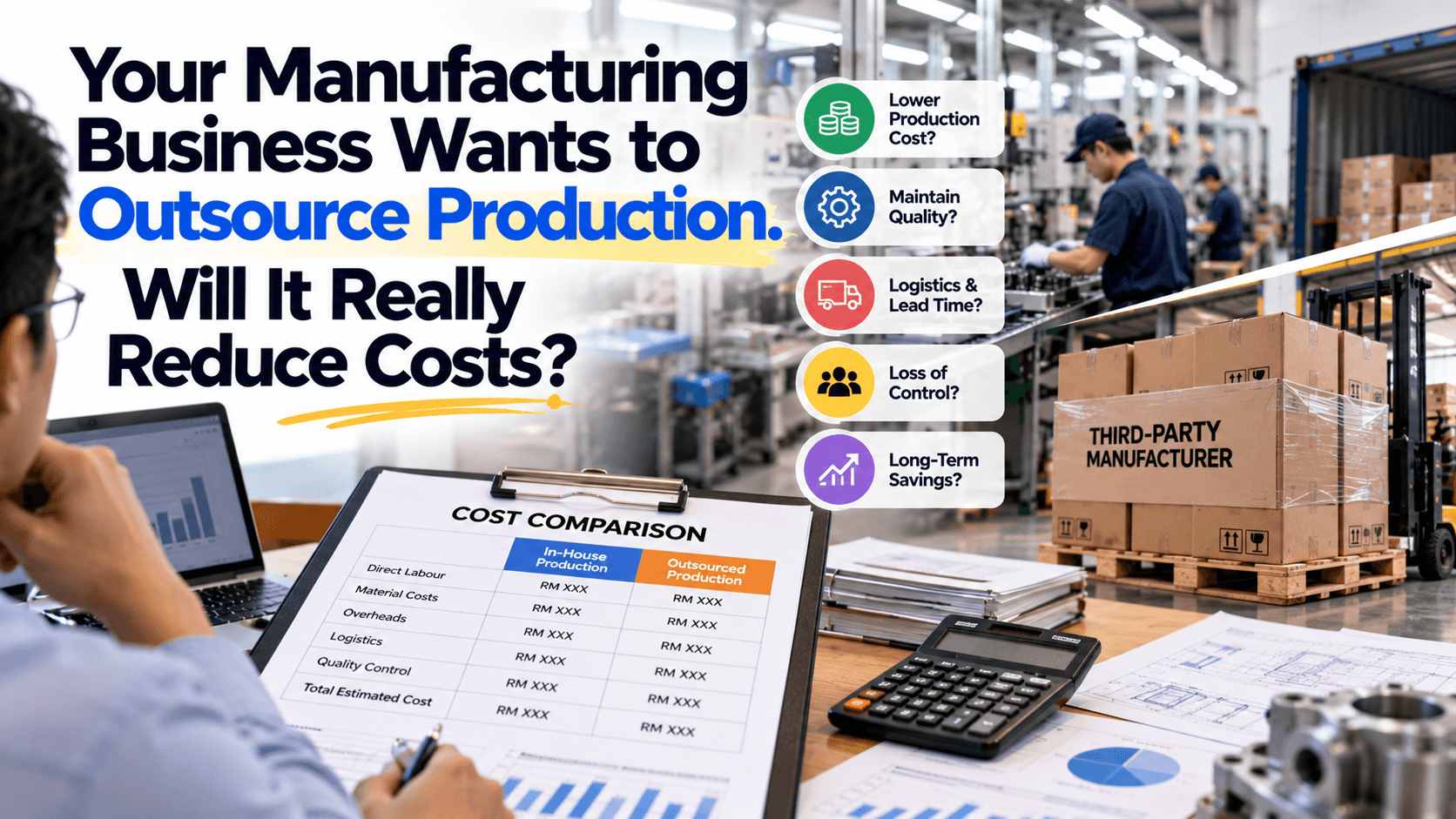
A supplier offers to manufacture a component for less than the unit cost shown in your production report. Your machines are ageing, recruitment has become difficult, and supervisors spend considerable time managing breakdowns and production delays. Outsourcing appears to offer both savings and a simpler operation.
However, a lower supplier price does not automatically translate into a lower total cost for your business. Some existing expenses may continue after production moves outside. New spending on transport, inspections and inventory may also emerge, while the transition itself can require significant cash.
The decision needs a clear comparison of what changes under each option. Before committing, management should understand which internal costs would disappear, what the supplier’s quote actually includes and whether the business can manage the financial consequences of relying on an external producer.
Define Exactly What You Plan to Outsource
“Outsource production” can describe very different arrangements. You might buy a finished component instead of making it, send your own materials to a subcontractor for processing, or transfer an entire product line while retaining final inspection and packaging.
Each arrangement changes the costs and responsibilities in a different way. If your company continues purchasing materials, the supplier’s processing fee cannot be compared directly with an internal unit cost that includes those materials. If the supplier delivers an unfinished component, you still need to account for the remaining production stages.
Write down the proposed division of responsibilities before building the financial comparison. Identify who supplies materials, owns tooling, carries out inspections, manages rejected batches and pays for transport. Specify the required quality, output and delivery schedule.
This also helps prevent different teams from evaluating different proposals. Procurement may assume the supplier will deliver finished goods, while operations expects to complete additional work internally. A financial model built on that misunderstanding can overstate the savings before the first order is placed.
Separate Costs You Can Avoid From Costs That Remain
An internal unit cost often includes allocated factory expenses. Rent, supervision, depreciation and administrative support may be spread across products to help measure overall profitability. Those allocations are useful, but they do not establish what the business would save by outsourcing one activity.
For the decision, identify the future costs that actually change. Materials purchases may fall, while a factory lease may continue. Labour savings depend on what happens to the employees and their pay, rather than simply whether production hours fall.
Ask the responsible manager to explain each proposed saving and when it would begin. “Lower maintenance” should identify the contract, equipment or work that would no longer be required. “Reduced staffing” should reflect an achievable plan and any associated transition costs.
Keep a separate category for costs that remain unchanged. This prevents the model from treating an accounting allocation as money that becomes available for another purpose.
A Lower Price Can Still Produce a Higher Monthly Cost
Consider a simplified hypothetical manufacturer producing 10,000 components each month. Its internal report shows a cost of S$12 per component, made up of S$5 for materials, S$3 for labour, S$1 for variable production expenses and S$3 for allocated fixed factory costs.
An external supplier quotes S$10 per component. Comparing S$10 with S$12 suggests a monthly saving of S$20,000. However, management’s review finds that only S$10,000 of the S$30,000 fixed factory cost would disappear. The remaining S$20,000 would continue.
Assume, for this example, that all S$90,000 of materials, labour and variable production expenses would stop. The total avoidable monthly cost is therefore S$100,000. The supplier’s invoice would also be S$100,000, so there is no saving before additional outsourcing costs.
If freight and incoming inspections add S$5,000 a month, total expenditure becomes S$125,000: S$100,000 for the supplier, S$20,000 of retained factory costs and S$5,000 of additional expenses. That is S$5,000 more than the original S$120,000.
The example excludes tax, transition costs and any benefit from redeploying capacity. It demonstrates why the quoted price must be compared with the costs that genuinely change. If some labour expenses also remain, the proposed arrangement becomes more expensive unless other benefits compensate for them.
Build a Complete Delivered Cost
A quotation needs to be translated into the cost of receiving usable output at the required location. Depending on the arrangement, additional amounts may include freight, insurance, handling, inspections, packaging or applicable duties and non-recoverable taxes.
Check the commercial assumptions behind the price. It may apply only above a minimum order quantity, require a particular batch size or exclude material price increases. A quote based on long production runs may not suit a business that needs frequent small orders.
Also establish what happens when requirements change. Additional tooling, sample runs, revised specifications and urgent deliveries may attract separate charges. These costs can be significant for a manufacturer whose customers regularly request modifications.
Avoid adding a broad contingency and assuming it resolves every uncertainty. Identify the major unknowns individually, obtain clarification where possible and show a reasonable range where the amount cannot yet be established. Management can then see which assumptions have the greatest influence on the result.
Put Quality Performance Into the Financial Comparison
A low-priced component creates little value if it cannot be used reliably. Defective output can increase inspection work, interrupt assembly and delay customer deliveries. Even when the supplier replaces rejected units without charge, your business may still carry the cost of disruption.
Use trial production to examine the process before assuming that the supplier can match your requirements consistently. Review acceptance results across a meaningful batch, rather than relying only on a few carefully prepared samples. Record inspection time and any additional internal work needed to make the output usable.
Translate observed problems into costs where you can. These might include sorting, rework, extra freight or production time lost while awaiting replacements. Keep estimates separate from confirmed costs so that the model does not present uncertain consequences as established facts.
Agree how defects will be identified and handled. The commercial discussion should address response times, replacement arrangements and responsibility for related expenses. Finance can then assess the proposed arrangement using a clearer picture of the quality risk your business retains.
Check Whether Lower Production Costs Require More Inventory
Your factory may currently make small batches close to the date they are needed. An external supplier may require larger orders and longer lead times. The change can increase stock levels even if the purchase price per unit is attractive.
For example, moving from weekly production to orders covering several months may require cash to be committed much earlier. Extra inventory also needs storage and creates exposure if customer demand falls or a product specification changes.
Map the proposed ordering cycle from deposit to customer collection. Include manufacturing lead time, transit, inspection and the period before finished goods are sold. Compare that cycle with the current arrangement rather than assuming that the same working capital will support both.
Distinguish the cash invested in inventory from the cost of holding it. The purchase uses cash, but it is not automatically an immediate expense in full. Financing, storage and potential obsolescence introduce separate costs that should be considered without double counting the stock purchase.
Decide What Happens to the Capacity You Release
Outsourcing can create value by releasing a constrained production line for more profitable work. However, that benefit needs a credible alternative use. Empty space and idle machines do not generate a return simply because they are available.
If another product could use the released capacity, examine demand, contribution and additional operating requirements. Confirm that the capacity being freed is actually the limiting factor. There may be little benefit if sales demand or another production stage remains the constraint.
Keep revenue separate from contribution. A replacement product expected to generate S$80,000 in sales does not create an S$80,000 benefit if it requires substantial materials, labour and other spending. Include the incremental contribution after those costs.
If machinery could be sold or space sublet, assess the likely proceeds, timing and practical restrictions. Do not assume an asset can be sold at its recorded value or that a lease permits the proposed use. Unsupported disposal assumptions can make outsourcing look more attractive than it is.
Budget for the Period When Both Operations Run
Production transfers rarely happen at no cost. The supplier may need tooling, technical documentation, sample approval and staff support before regular orders begin. Your internal line may need to continue operating during that period.
Prepare a transition budget separate from the ongoing comparison. Include trial batches, duplicated activity, training, equipment movement and any expected exit costs. If employees are being redeployed, allow for the time and resources needed to make that change effective.
Build the timing into the cash forecast. Supplier deposits could fall due while you are still paying the full cost of internal production. An arrangement that produces acceptable annual savings may still create a difficult short-term cash requirement.
Set milestones for releasing further commitments. Approval of samples, successful trial deliveries and stable production results can provide evidence for the next stage. This makes the transition plan easier to control than committing to the entire transfer before the process has been demonstrated.
Assess How Dependent You Would Become on the Supplier
A supplier relationship changes the way your business responds to disruption. When production is internal, management can directly adjust schedules and investigate problems. With an external producer, your orders compete with its other commitments and priorities.
Understand how much capacity the supplier has committed to you and what flexibility is available during peak demand. Discuss lead times for urgent orders and the effect of volume reductions. A contract that works well at a steady forecast may become costly when customers change their requirements.
Consider how quickly another source could be approved. Access to tooling, technical drawings and quality records can affect your ability to move production. If switching would take months, that dependence belongs in the decision even when its cost cannot be reduced to one precise figure.
The practical response may involve retaining some internal capability or qualifying another supplier. Those measures have costs, which should be included if they form part of the operating plan. Outsourcing should not be evaluated on the assumption of uninterrupted supply while the actual business intends to pay for backup capacity.
Compare the First Year With the Longer-Term Position
The first year may include transition spending and retained commitments that end later. Conversely, an attractive introductory price may increase when the initial contract expires. One monthly comparison cannot represent both periods accurately.
Prepare a view of the transition year and a separate view of the expected ongoing arrangement. Identify when savings begin, when existing commitments expire and when supplier pricing can change. Where significant investment is involved, assess cash flows over an appropriate period rather than relying only on a simple payback figure.
Test the assumptions that could change the conclusion. Lower demand, higher freight charges, slower supplier approval or a less favourable exchange rate may reduce the expected benefit. Use scenarios tied to the actual arrangement rather than applying an arbitrary percentage to every cost.
Present the outcome as a range where uncertainty remains. Management should understand both the expected saving and the conditions required to achieve it.
Make the Decision With Evidence You Can Review Later
A useful outsourcing proposal brings together the supplier quotation, internal cost analysis, retained commitments, transition budget and cash forecast. Operations, procurement and finance should agree on the main assumptions and identify who is responsible for delivering each expected benefit.
If outsourcing proceeds, compare actual results with the proposal. Track delivered cost, usable output, stock levels, quality expenses and realised internal savings. A lower purchase price alone does not demonstrate success if other costs have increased or planned savings have not occurred.
Lee & Hew provides accounting and financial reporting services that can support a clearer understanding of business costs and performance. Reliable records give manufacturing owners a stronger foundation for reviewing proposals and measuring what changes after implementation.
Outsourcing may reduce costs, release capacity or provide access to capabilities your business would struggle to develop internally. The decision is strongest when those benefits are supported by evidence, the remaining costs are visible and the company has enough cash to manage the transition.