
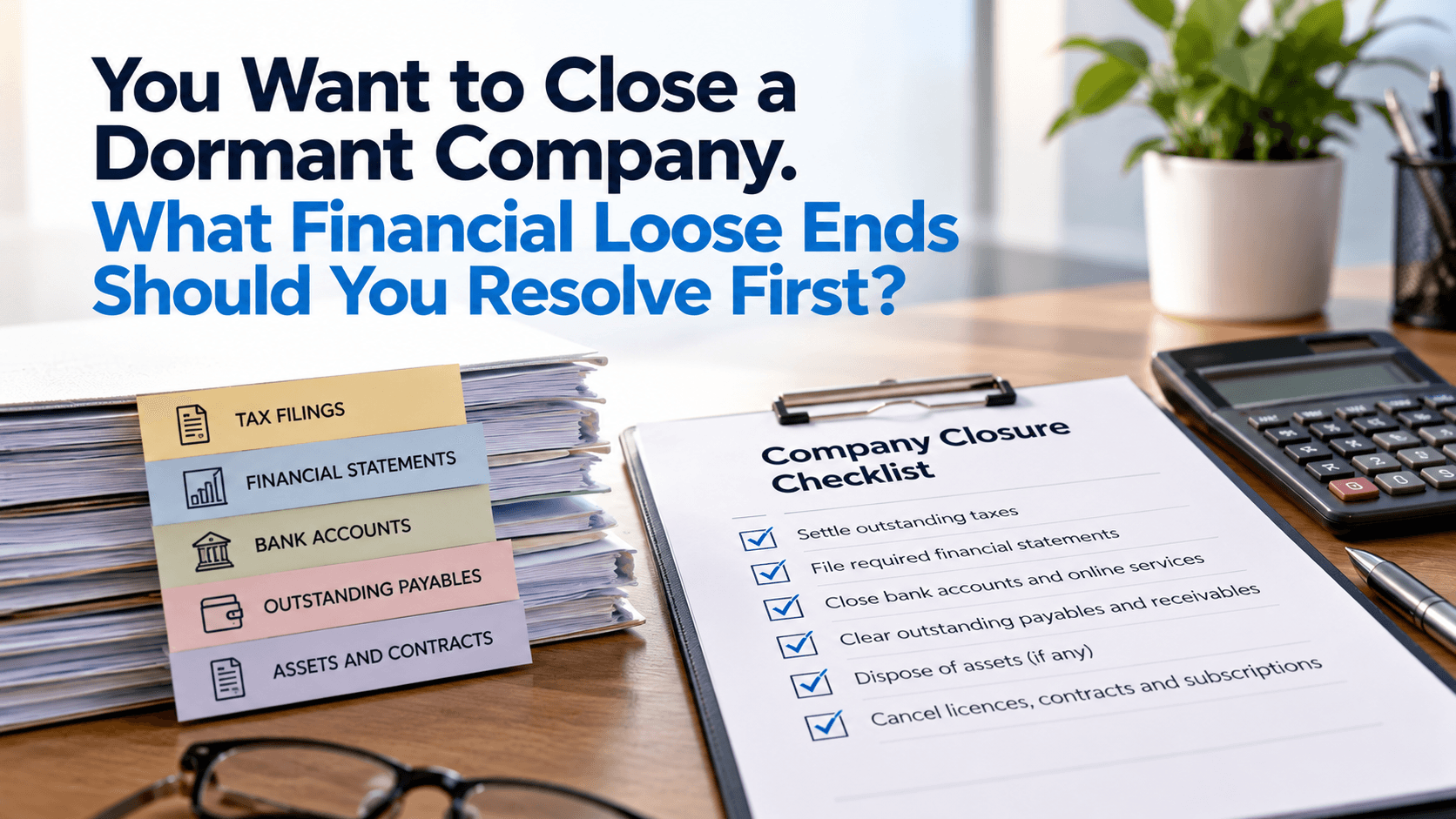
The company has not taken on customers for some time. Its original project ended, the business moved into another entity, or the owners decided against pursuing the opportunity. Yet the company remains registered, and someone still needs to deal with its records, correspondence, and administrative costs.
Closing it may seem straightforward because there is no active business to wind down. However, inactivity does not necessarily mean the company has nothing left to collect, pay, own, or explain. An old bank balance, a shareholder loan, or an unresolved tax matter can complicate the process.
Before starting the closure application, establish the company’s actual financial position. The objective is to resolve the underlying matters properly, with records that explain what happened, rather than simply make the accounting balances disappear.
Dormancy and Readiness for Closure Are Different Questions
A company described informally as dormant may still hold assets or owe money. It might have stopped trading while retaining a rental deposit, an intercompany receivable, or funds contributed by a director.
For a Singapore local company seeking striking off, ACRA’s criteria include having ceased business or never commenced it, having no assets or liabilities, and meeting other conditions concerning government matters, registered charges, proceedings, and directors’ consent. Inactivity alone is insufficient.
Dormancy for tax purposes also has its own requirements. IRAS describes a dormant company as one that did not carry on business and had no income during the financial year. Confirm the relevant status with your advisers rather than assuming that no customer invoices means every dormancy or closure condition is satisfied.
Start With a Current Financial Position
Retrieve the latest accounts and determine how far they have been completed. If bookkeeping stopped when trading ended, there may be later transactions that have never been recorded.
Review bank statements, invoices, receipts, and correspondence from the last completed accounting period onwards. Look for bank charges, professional fees, subscription renewals, refunds, and payments made on the company’s behalf. These can change the position even when there have been no sales.
Prepare an updated list of assets, liabilities, and unresolved items. Give each balance an explanation, supporting evidence, and a proposed next action. This becomes the working document for the closure review and helps management identify where accounting, tax, or legal advice is needed.
Check What Is Still in the Bank
A bank account with a small balance can be easy to overlook, particularly if it is rarely used. Reconcile every account and identify pending payments, recurring deductions, and receipts that are still expected.
Suppose a company has S$4,000 in its bank account, an unpaid professional fee, and a possible tax refund. Transferring the full balance to an owner and immediately closing the account could make the remaining tasks more difficult.
Agree on the sequence for settling obligations, receiving outstanding amounts, dealing lawfully with any remaining funds, and closing the accounts. Keep statements and closure confirmations. Money belonging to the company should not be treated as an owner’s personal balance without establishing the proper basis for the payment.
Investigate Deposits and Other Recoverable Amounts
Inactive companies sometimes retain deposits with landlords, utilities providers, suppliers, or other service providers. These may remain recoverable long after the underlying activity has ended.
Check each deposit against the relevant agreement and correspondence. Establish whether it has already been refunded, applied against a final bill, forfeited under an agreement, or remains outstanding. Where a refund is due, identify who will pursue it.
For example, an old office deposit may still appear in the accounts even though the landlord deducted reinstatement costs and refunded the remainder. The correct next step is to obtain the settlement documents and reconcile the transaction. Writing off the entire balance without investigation would lose the explanation and could obscure money still owed to the company.
Resolve Customer and Supplier Balances
An unpaid customer invoice remains a matter to address even if the company no longer trades. Likewise, an old supplier balance does not disappear because the supplier has stopped sending reminders.
Review correspondence, payments, credit notes, and any disputed amounts. Some balances may result from incomplete bookkeeping, while others represent genuine rights or obligations. Separate the two before deciding how to proceed.
If collection is doubtful or a creditor proposes a settlement, obtain advice appropriate to the circumstances and document the outcome. An accounting write-off does not necessarily extinguish the underlying legal right or debt. The closure review needs to establish what has actually been resolved, not merely what has been removed from the ledger.
Give Director and Shareholder Loans Particular Attention
Owners often fund a company’s early expenses personally. When the business becomes inactive, those amounts may remain recorded as loans or balances payable to directors or shareholders.
Confirm who is owed money, how the balance arose, and whether both parties agree on the amount. Check for expenses that were paid personally but never entered into the company’s records, as well as repayments that were recorded incorrectly.
Repayment, waiver, or another arrangement can have different accounting, tax, and legal consequences. Do not clear the account using an unexplained journal entry simply to produce a zero balance. Agree on a valid course of action with the relevant parties and retain the documents supporting it.
Reconcile Balances With Other Group Companies
A dormant company within a group may have transactions that were handled informally. Another entity might have paid its annual fees, collected money on its behalf, or funded a purchase.
Compare the balance recorded in each company’s accounts. If one entity shows S$18,000 receivable while the other records only S$12,000 payable, identify the missing or inconsistent entries before arranging settlement.
Being under common ownership does not remove the need to resolve the position between separate legal entities. Where a transfer, settlement, or waiver is proposed, assess the implications for both sides. The active company’s records should explain the outcome just as clearly as those of the company being closed.
Look Beyond Assets With a Significant Book Value
An asset register showing little or no net book value does not establish that the company owns nothing. Fully depreciated equipment may still exist, and the business may also own inventory, investments, or other rights.
Identify what remains and confirm ownership. If equipment has moved to another group company or into an owner’s possession, establish whether there was a documented sale, transfer, or other lawful arrangement.
Keep evidence of disposals and consider their accounting and tax treatment. For instance, an old laptop recorded at zero may still have a resale value. Depreciation in the accounts is different from transferring ownership or disposing of the item.
Check Contracts, Guarantees, and Unbilled Commitments
Some obligations will not be obvious from the latest balance sheet. Review contracts, guarantees, leases, service arrangements, and correspondence for matters that remain open.
A company may have stopped using a subscription while the contract continues to renew. It may also have given a guarantee connected to another business or face an unresolved complaint from its trading period. These matters require attention even if no current invoice has been received.
Obtain written confirmation of termination or release where appropriate. Ask advisers about uncertain obligations rather than declaring the company free of liabilities based solely on the accounting records. A closure review should consider what the company may still be responsible for.
Settle Corporate Tax Matters Before Applying
IRAS requires companies to settle outstanding tax liabilities and obligations before applying to ACRA for striking off. Outstanding tax matters can lead IRAS to object to the application.
Review filing status, assessments, payments, enquiries, and any remaining obligations up to cessation. A previous dormant-company filing waiver should not be treated as evidence that every tax issue has been resolved. Confirm the actual position through the company’s records and relevant IRAS services.
Check for tax credits as well as amounts payable. IRAS warns that credits remaining after dissolution are transferred to the Insolvency and Public Trustee’s Office, creating an additional process for shareholders seeking recovery. Addressing refunds before dissolution can avoid unnecessary complications.
Treat GST Deregistration as a Separate Task
If the company is GST-registered, stopping business does not by itself complete its GST obligations. Review the cancellation requirements and coordinate the effective date with the remaining transactions.
IRAS requires cancellation applications within 30 days in specified circumstances, including cessation of business. Outstanding returns and payments must be addressed, and a final GST F8 return is required. Certain assets held at deregistration may also require output tax to be accounted for under the applicable rules.
This is particularly relevant if equipment, stock, or other assets remain. Ask your tax adviser to assess the actual position before disposing of or transferring them. Do not assume that a company with no recent sales has no remaining GST work.
Confirm the Appropriate Closure Route
Striking off is subject to eligibility conditions. If the company still has unresolved obligations, a dispute, or difficulty paying creditors, obtain advice on the appropriate next steps rather than attempting to fit the circumstances into a striking-off application.
The choice of closure route should follow the company’s financial and legal position. A solvent company with matters to distribute or settle may require a different approach from one that cannot meet its debts.
This assessment should happen before money is transferred or assets are moved. Establishing the right sequence early can prevent actions that complicate the position of creditors, shareholders, or directors.
Keep Records Accessible After Operations End
Closure preparation often involves cancelling software subscriptions and returning equipment. Before doing so, preserve the accounting data and supporting records needed for future reference and applicable retention obligations.
Export usable records from accounting and payroll systems, including transaction details, ledgers, reconciliations, returns, and supporting schedules. Check that the files can actually be opened and understood without relying on a subscription that will soon expire.
Agree on who will retain the records, where they will be stored, and who can access them. Confirm the applicable retention periods with your advisers. Confidential information should remain protected, but it should not become inaccessible simply because the company’s operational systems have been switched off.
Assign Responsibility Until the Process Is Complete
Prepare a closure action list covering financial balances, tax matters, contracts, banking, records, and the application itself. Assign an owner and supporting evidence to each item.
Keep a reliable contact and correspondence arrangement while the process is underway. A submitted application is not the same as completed dissolution, and questions or objections may still need a response.
Before filing, review whether the actions taken have genuinely resolved the relevant matters. ACRA advises applicants to monitor the striking-off process until the company has been successfully struck off. Keep responsibility clear through that final stage rather than treating submission as the end of the work.
Bring the Financial and Administrative Work Together
Lee & Hew PAC’s professional services include accounting, audit, tax, and company secretarial support. For owners considering closure, these areas need to be coordinated so that the accounts, tax position, and proposed corporate action tell a consistent story.
Begin the discussion with current financial records, a list of outstanding balances, relevant contracts, and the company’s filing status. Explain any uncertainty about money owed, assets held, or transactions with owners and related companies. This helps advisers identify what must be addressed before an application is appropriate.
Closing a dormant company should leave a clear record of how its affairs were resolved. Before proceeding, establish what it still owns, what it owes, what obligations remain, and who will complete each task. That preparation gives the closure process a sound financial foundation.