
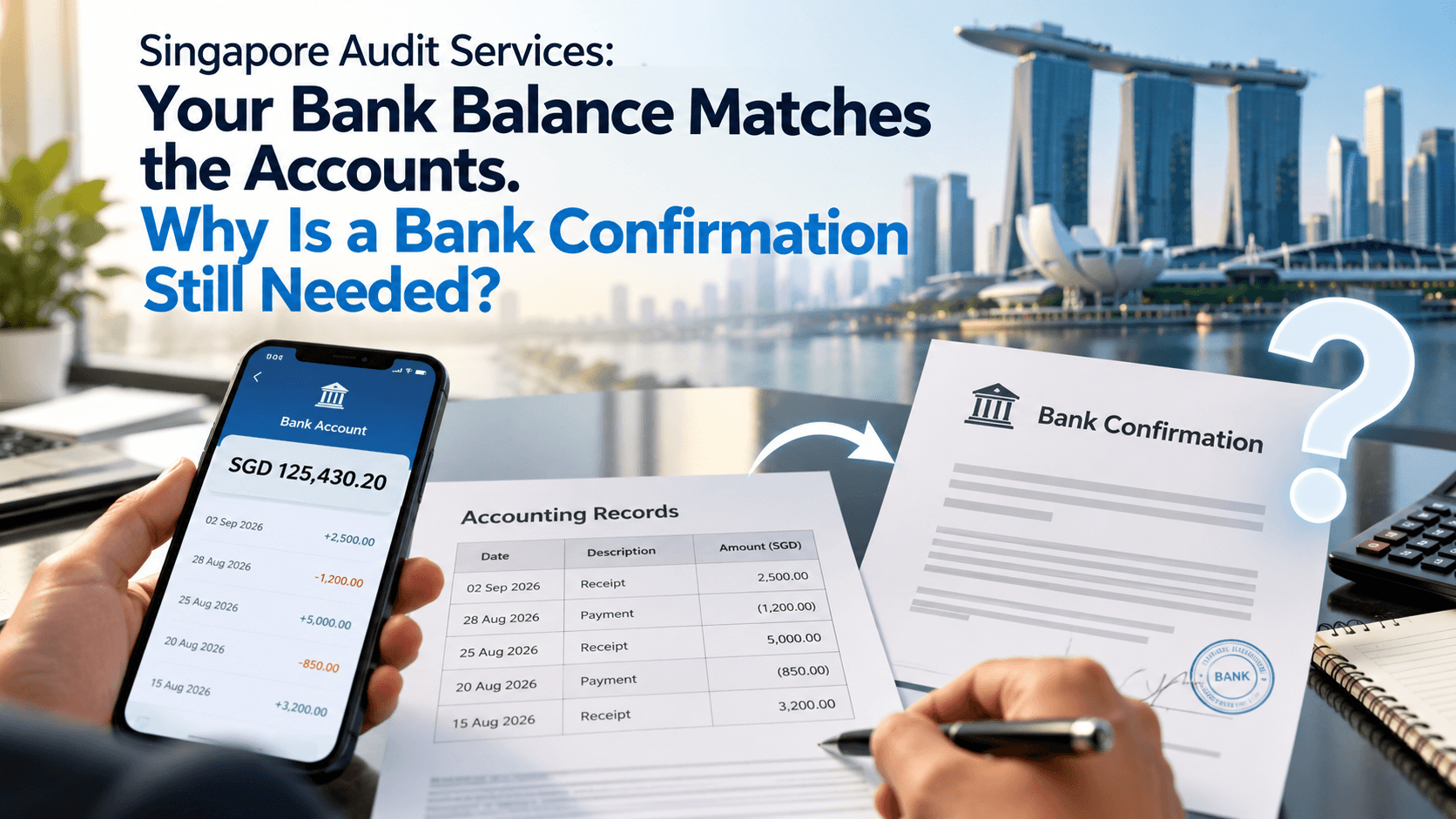
Your finance team has completed the year-end bank reconciliation. The balance in the accounts agrees with the bank statement, and any outstanding items have supporting explanations. From management’s perspective, the cash balance appears settled.
Then the auditor asks you to authorise a bank confirmation. It can feel like another administrative step to verify a number that everyone has already checked. If the bank statement and accounting records agree, what additional information could the auditor need?
For businesses engaging Singapore Audit Services, the answer involves both the source of the evidence and the information being requested. A bank confirmation can provide evidence directly from the bank and may address arrangements beyond the amount shown in your current account. Understanding that purpose makes the request easier to prepare for and respond to.
A Matching Balance Answers One Important Question
A bank reconciliation explains how the balance recorded by your company relates to the bank’s records at a particular date. It helps identify differences such as outstanding payments, deposits in transit, bank charges, or entries that require correction.
That work remains important even when the final balances agree. Your finance team should retain the reconciliation, relevant statements, and evidence supporting any adjustments or outstanding items. The auditor may examine those records as part of the audit.
However, agreement between two figures does not settle every question about the company’s banking position. Management may also need to account for borrowings, pledged deposits, or other arrangements. The auditor’s work extends to whether relevant balances and disclosures are supported, rather than stopping at a single matching number.
Why the Source of the Information Matters
An external confirmation is a response received directly by the auditor from a third party. In a bank confirmation process, the auditor maintains control over the request and evaluates the response as audit evidence.
Management usually helps by providing the necessary authorisation and accurate company details. That cooperation allows the bank to release information through the agreed process without turning management into the intermediary responsible for supplying the confirmation response.
This does not mean that every document provided by your finance team is unreliable. It means the auditor uses evidence from different sources for different purposes. A company-supplied bank statement and a response obtained directly from the bank do not have exactly the same evidential characteristics.
The Request May Cover More Than Cash
Depending on the request and the bank’s response, a confirmation may address loans, overdraft arrangements, guarantees, securities, pledged assets, or outstanding foreign exchange contracts. Its scope should not be assumed to cover every possible banking relationship automatically.
For example, your current account may show S$400,000, with the accounting records reflecting the same amount. Separately, the company may have a bank guarantee supported by a deposit. The current account balance alone does not explain that arrangement.
The auditor may need further documents to understand its terms and assess the accounting implications. A confirmation can therefore introduce questions that appear unrelated to the reconciled balance but are relevant to the financial statements.
Money in the Bank May Have Conditions Attached
Business owners often interpret a bank balance as money available for ordinary spending. In practice, some deposits may be pledged or subject to restrictions that management needs to understand.
Imagine a hypothetical company with S$250,000 in a fixed deposit pledged as security for a financing arrangement. The deposit exists, and its amount may be correctly recorded. However, management should also understand whether it can be withdrawn freely and how the arrangement affects financial reporting.
The appropriate presentation and disclosure depend on the facts and applicable accounting requirements. Provide the auditor with the relevant agreements and correspondence rather than relying on the account description alone. The words “fixed deposit” do not explain every condition attached to the funds.
Borrowing Arrangements Can Raise Separate Questions
Cash and borrowing should be considered together when preparing banking information for the audit. A company may have several accounts with a bank, alongside a term loan or other facility managed through separate correspondence.
For example, finance may reconcile the operating account each month while the managing director handles discussions about a business loan. Unless information is shared, the accounting team may not have the latest repayment schedule or amendment letter.
Before the audit, bring these records together. Identify outstanding facilities, relevant agreements, and changes during the year. This helps the auditor understand the arrangements and allows management to answer questions without searching across multiple people’s inboxes.
A Zero Balance Does Not Explain the Whole Relationship
An account with no money in it may still be part of a relevant banking relationship. Similarly, an account closed during the year may have transaction history or closure information that the auditor needs to consider.
Do not remove accounts from the information provided to the auditor simply because their closing balances are small or nil. Give a complete account list and explain which accounts are active, dormant, or closed. The auditor can then determine the appropriate procedures.
As an illustration, a company might stop using an old operating account after changing banks. Its year-end balance is zero, but transactions occurred earlier in the reporting period. Keeping the statements and closure records makes that history easier to follow.
A Confirmation Does Not Replace the Reconciliation
Receiving a bank response does not complete every aspect of auditing cash. The auditor may still need to examine reconciling items, transactions around year-end, and the accounting treatment of information identified.
Suppose the bank confirms S$180,000 while the ledger shows S$165,000. A payment recorded by the company but not yet processed by the bank might explain the difference. The reconciliation and subsequent records would help establish what happened.
A difference is therefore not automatically evidence of an error. Equally, labelling an amount as a timing difference does not resolve it without support. The finance team should be able to explain each material reconciling item and provide evidence of its status.
The Confirmation Date Needs to Match the Purpose
Management sometimes provides a screenshot of the current bank balance when the audit concerns a previous year-end. Although the screenshot may be useful for another purpose, it does not directly establish the balance at the earlier reporting date.
For a company with a 31 December year-end, the request will ordinarily identify the relevant date being confirmed. Check that date carefully when completing authorisation details, especially if more than one reporting period is involved.
Also confirm the correct legal entity. Companies within a group may have similar names or use the same bank, but their accounts and obligations are distinct. Accurate names, registration details, and request references help avoid an unnecessary administrative mismatch.
Management Can Help Without Handling the Auditor’s Response
Your role is to support a properly authorised process and provide the information needed to initiate it. Ask the audit team which details and actions are required, then follow the bank’s applicable procedure.
Digital arrangements differ between banks. For example, DBS provides an audit confirmation feature through DBS IDEAL that allows an organisation to authorise confirmation of its positions and balances to its auditors. Its instructions require details such as the financial year-end and auditor’s email address.
Coordinate those details with the audit team before submission. Avoid assuming that downloading a document and forwarding it yourself will satisfy the auditor’s planned confirmation procedure. The route by which the response is received forms part of the evidence assessment.
Prepare Early Enough to Resolve Administrative Problems
A request can be delayed by practical issues that have little to do with the accounting balance. An authorised person may be unavailable, an account administrator may need to arrange access, or the request may contain outdated audit firm details.
Identify the person responsible for authorisation early in the audit timetable. Check the bank’s current instructions, any applicable charges, and the information needed for the request. Keep a record of submission and status so that follow-up is organised.
For businesses using several banks, maintain a simple tracker showing the institution, relevant entity, request date, and outstanding action. Coordinate follow-ups with the auditor to avoid duplicate requests or uncertainty about which response relates to which reporting period.
What Happens if the Bank Does Not Respond?
A missing response does not count as confirmation that everything is correct. The auditor must consider follow-up and whether other procedures can provide the evidence required.
Under the external confirmation standard, alternative procedures may be appropriate for non-responses. However, where a positive confirmation response is necessary to obtain sufficient appropriate evidence, alternatives cannot simply replace it. Unresolved evidence limitations may affect the audit conclusion or reporting.
Raise delays promptly rather than assuming the audit team can omit the procedure. Management can help resolve authorisation or contact issues while the auditor determines how to address the evidence requirement. A bank delay does not automatically mean a modified opinion, but it should not be ignored.
Treat Unexpected Information as Something to Investigate
A confirmation may identify information that finance did not expect. This could involve a security arrangement, a balance difference, or a facility that management believed had ended.
Start by checking the relevant documents and discussing the matter with the auditor. An unexpected item may reflect incomplete internal communication, an administrative issue, or a genuine accounting matter. Establish the facts before deciding on the response.
For instance, management might believe a guarantee has expired while the bank’s records indicate that it remains outstanding. Obtain clarification and supporting evidence rather than simply removing it from the working papers. The audit team can then assess the implications using the resolved facts.
Use the Process to Improve Your Own Banking Records
The confirmation exercise can reveal where information is too dependent on one person. If only a director knows about guarantees or only a former employee retained facility letters, the business has a practical recordkeeping problem to address.
Maintain a central banking register covering accounts, facilities, key agreements, and responsible contacts. Update it when accounts are opened or closed and when financing arrangements change. Restrict access appropriately while ensuring authorised finance staff can obtain the information they need.
This register does not replace audit evidence or the bank’s records. It helps management keep its own understanding current and makes future reporting, cash planning, and audit preparation more organised.
Discuss Banking Information Early With Lee & Hew
Lee & Hew PAC provides financial statement audit and group audit services through Audit Services Singapore. When preparing for an engagement, share a complete picture of the company’s banking relationships, together with reconciliations and relevant supporting agreements.
Discuss authorisation arrangements and any known documentation gaps with the audit team at the planning stage. If the business has opened accounts, changed lenders, pledged deposits, or entered new financing arrangements, explain those developments early.
For companies engaging Singapore Audit Services, a matching bank balance is a useful starting point. Bank confirmations serve a wider evidential purpose and can help the auditor assess information beyond that figure. Understanding the request allows management to support the process efficiently while keeping a clearer record of the company’s financial arrangements.