
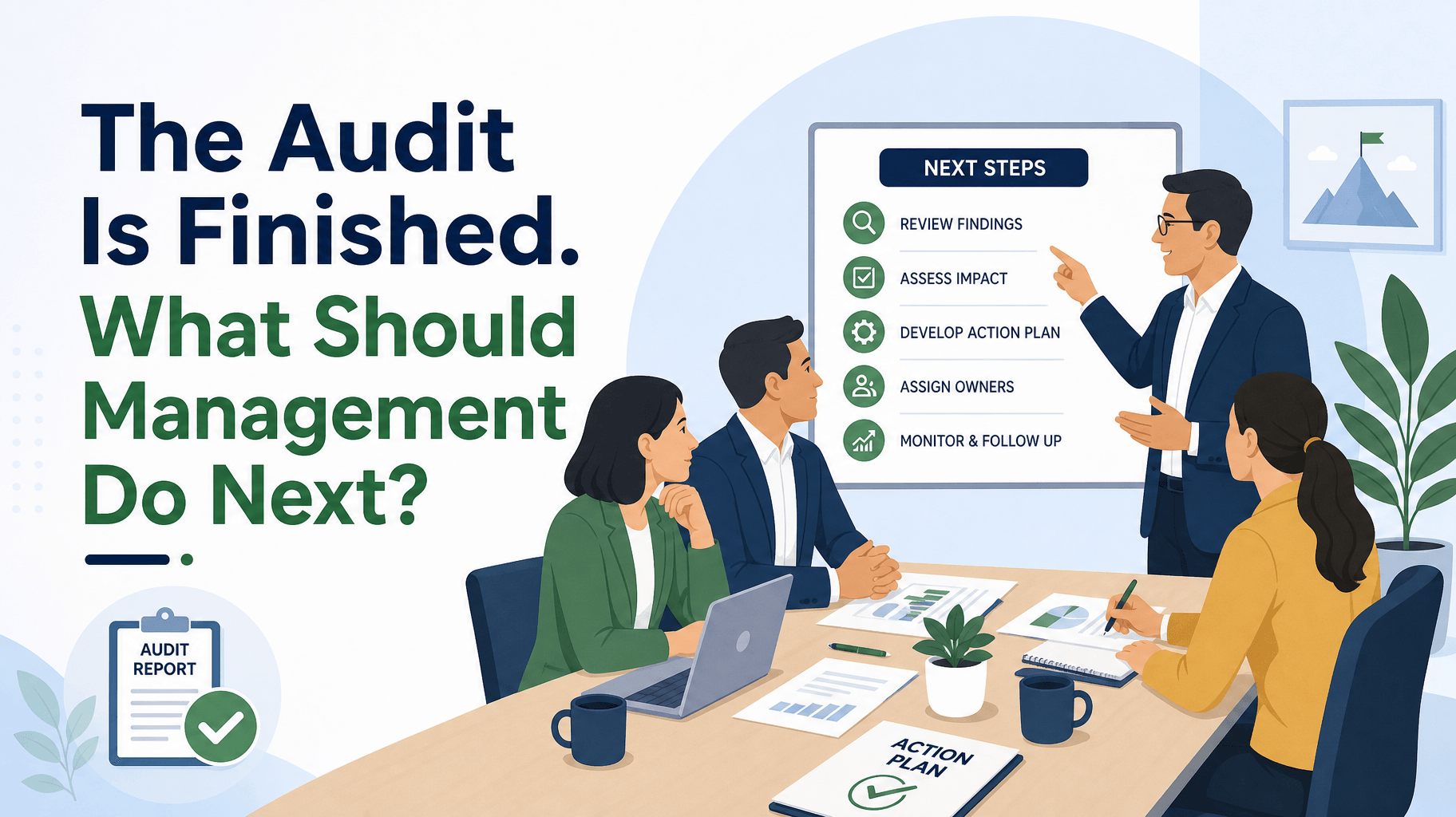
Completing an audit is an important milestone for any business. After weeks of answering questions, locating supporting documents, and reviewing financial information, management can finally turn its attention back to daily operations. Yet the period immediately after an audit is also a valuable opportunity to improve how the business works.
An audit can bring recurring difficulties into focus, from incomplete records and unclear approval processes to accounting tasks that depend too heavily on one employee. When management takes time to understand these issues, the work invested in the audit can support improvements that extend well beyond the next reporting cycle.
For businesses in Singapore, the next step is to turn relevant findings and observations into a manageable plan. That means understanding what has been communicated, deciding which matters deserve attention first, and assigning responsibility for meaningful follow-through.
Start by Understanding What the Audit Has Communicated
Before setting new tasks, management should make sure it understands the audit’s outcome and the scope of the work performed. A financial statement audit and an internal audit serve different purposes, so the conclusions and recommendations arising from them should be read in context.
For a financial statement audit, management should review the auditor’s report alongside any other communications provided during the engagement. Where an auditor has communicated observations or recommendations separately, these deserve their own discussion. Management should clarify unfamiliar terminology and ask questions about the implications of matters raised.
It is also important to avoid reading more into an audit outcome than it supports. An unmodified audit opinion does not mean that every transaction has been checked, every operational weakness has been identified, or every instance of fraud has been ruled out. Management remains responsible for the company’s records, financial reporting, and internal controls.
A focused closing discussion helps establish a shared understanding. Finance staff, relevant operational managers, and business leaders should leave knowing which matters require action and which questions still need clarification.
Bring the Right People into the Conversation
Post-audit follow-up often becomes a finance department responsibility by default. However, many issues affecting financial records begin elsewhere in the business. Sales teams agree commercial terms, purchasing staff engage suppliers, operations teams confirm deliveries, and managers authorise expenditure.
If a recurring problem concerns missing evidence that goods were received, asking finance to collect documents more aggressively may only address the final symptom. The receiving process itself may need clearer responsibilities and a reliable way to record acceptance.
Management should therefore involve the people who control the relevant activities. This does not require a large committee or a lengthy meeting. A short discussion with the right process owners can be more useful than circulating a report to everyone without explaining what they need to do.
The aim is to create shared ownership. Finance can explain how an issue affects accounting and reporting, while operational staff can help design a solution that works within everyday business routines.
Separate Immediate Corrections from Lasting Improvements
Some matters can be resolved by correcting a specific record. Others require a change in the process that produced the problem. Management should distinguish between these two types of work so that a completed correction is not mistaken for a permanent solution.
For example, an incorrectly recorded expense may be corrected during the audit. That resolves the individual accounting error, but it does not necessarily explain why the error occurred. Perhaps the invoice description was unclear, staff used inconsistent account codes, or no one reviewed unusual entries.
A lasting improvement would address the underlying cause. Depending on the circumstances, that might involve clearer coding guidance, better supporting documentation, or a review step for particular transactions.
This distinction helps prevent the same issues from returning each year. The useful question is not simply whether an item has been fixed, but whether the business has reduced the likelihood of the same problem happening again.
Prioritise Matters According to Their Business Impact
Management does not need to implement every improvement simultaneously. Attempting too much at once can overwhelm a small team and leave important work unfinished. A more effective approach is to assess the significance of each matter and set a realistic order of action.
Consider what could happen if an issue remains unresolved. Could it contribute to a significant reporting error, an unauthorised payment, the loss of important records, or repeated delays in closing the accounts? Also consider how frequently the affected process occurs and whether an existing safeguard reduces the exposure.
A weakness involving payment approvals may warrant more immediate attention than an inconsistent file-naming convention. However, apparently administrative problems should not be dismissed automatically. Missing or poorly organised documents can become consequential when they prevent management from understanding or substantiating transactions.
Where the implications are unclear, management should seek clarification from the auditor or an appropriate adviser. Priorities should reflect the company’s actual circumstances, rather than assumptions based only on how technical an observation sounds.
Give Every Agreed Action a Clear Owner
An improvement plan is only useful when someone is responsible for carrying it out. Instructions such as “improve documentation” or “strengthen review procedures” express an intention, but they do not define a task that can be completed and checked.
Each agreed action should identify the responsible person, the expected result, and a realistic completion date. The description should be specific enough that another manager can understand what successful implementation looks like.
For instance, a business might agree that the finance manager will introduce a monthly reconciliation review, with the preparer and reviewer recording their completion dates. This is more actionable than a general commitment to review accounts more carefully.
In smaller businesses, one person may own several actions. Management should take that workload into account and provide the necessary time, authority, and support. Assigning responsibility without making room for the work can turn a reasonable plan into a list of overdue promises.
Keep the Action Plan Simple and Visible
A post-audit action plan does not need sophisticated software. A shared tracker may be sufficient if it is kept current and reviewed by the appropriate people. Its purpose is to make progress visible and prevent agreed actions from disappearing into email chains.
Useful information includes the matter identified, the action agreed, the person responsible, the target date, and the current status. Management should also record what evidence will demonstrate completion, such as an approved procedure, a completed reconciliation, or a sample of documented reviews.
Care is needed when recording sensitive findings. Access should be appropriate to the information involved, particularly where the discussion concerns employee conduct, payment permissions, or confidential commercial arrangements.
The tracker should support discussion rather than replace it. When an action is delayed, management needs to understand whether the obstacle is a lack of resources, an unclear decision, or a proposed solution that does not work in practice.
Strengthen Documentation Where Work Actually Happens
Businesses often respond to audit difficulties by asking employees to retain more documents. That can help, but the stronger question is whether evidence is being captured at the point where a decision or transaction occurs.
If a manager approves expenditure verbally, finance may later struggle to establish who authorised it and on what basis. If a customer agrees to a change in terms through an informal exchange, the accounting team may never receive the information needed to understand the arrangement.
A practical improvement is to define what should be recorded, where it should be stored, and who is responsible for doing so. The method should be easy enough for staff to follow consistently, whether it uses existing business software, a shared folder, or a standard approval form.
Good documentation should allow someone unfamiliar with a transaction to understand its purpose and supporting evidence. Collecting large quantities of files without a clear structure is unlikely to achieve that result.
Check Whether New Procedures Work in Practice
Introducing a procedure is the beginning of implementation. Management should subsequently check whether employees understand it, follow it, and produce the intended evidence.
Suppose a company introduces a requirement for an independent review of supplier bank-detail changes. A follow-up check should establish whether relevant changes received that review before payments were processed. The existence of a written policy alone does not demonstrate that the safeguard operated.
The depth and frequency of follow-up should reflect the significance of the process. A small business may use a targeted management review, while a more complex organisation may need a more structured assessment.
Where a new procedure is not being followed, management should investigate the reason. The process may be unnecessarily complicated, responsibilities may overlap, or employees may lack access to the information they need. Effective follow-up creates an opportunity to refine the solution instead of simply repeating instructions.
Use the Experience to Improve the Next Reporting Cycle
Once immediate follow-up is underway, management should review what made the audit process difficult. This discussion can reveal opportunities to reduce avoidable disruption for both finance staff and operational teams.
Consider which information requests took longest to answer and why. Were documents unavailable, account balances insufficiently explained, or key schedules prepared only when requested? Were responsibilities unclear when the auditor needed information from another department?
The answers can inform improvements to routine work. Preparing supporting schedules regularly, resolving unexplained balances promptly, and documenting significant transactions when they occur can reduce the amount of reconstruction needed later.
The objective is to improve the reliability and accessibility of information throughout the year. A smoother future audit is one benefit, but management also gains a clearer basis for understanding the business between reporting deadlines.
Build Accountability Without Creating a Blame Culture
Audit observations can make employees defensive, especially when teams have worked under pressure or inherited processes that were never clearly documented. Management’s response can determine whether people disclose problems openly or become reluctant to raise them.
A constructive approach separates accountability from blame. Employees should understand their responsibilities, but discussions should also consider workload, training, system limitations, and the quality of existing instructions.
For example, repeated delays in preparing reconciliations may reflect competing responsibilities or a dependency on information from another team. Addressing those constraints may produce a better result than simply setting a stricter deadline.
This does not remove the need to respond appropriately to serious concerns. It means that routine improvement work should encourage accurate explanations and practical solutions. Management learns more when employees can describe how work actually happens.
Decide Whether Further Professional Support Is Needed
Some post-audit actions can be handled internally. Others may require expertise or a more detailed review, particularly where management needs to understand a complex accounting matter or assess a broader process weakness.
The scope of any additional engagement should be clear. Management should explain the question it needs answered, the area to be reviewed, and the expected output. Where the financial statement auditor is being considered for additional work, the parties should discuss whether that work is appropriate within applicable independence requirements.
Audit Services Singapore, through Lee & Hew, lists financial statement audits, internal audits, and specialised audit services among its offerings. Businesses can discuss their circumstances with the firm to understand which service, if any, is suitable for the follow-up work they have identified.
Turn Completion into Measurable Progress
The end of an audit creates a useful moment for management to pause, review, and act. The most valuable next steps are usually concrete: clarify the outcome, identify the underlying causes of recurring problems, assign a manageable set of actions, and check whether those actions work.
Progress does not require a complete redesign of the finance function. A clearer approval process, a properly documented review, or a more reliable handover between teams can make an important difference when implemented consistently.
By treating post-audit follow-up as part of normal management responsibility, businesses can carry the lessons of the engagement into everyday operations. The audit may be finished, but the improvements it helps management identify can continue to strengthen the business long afterwards.