
Buying AI Was the Easy Part
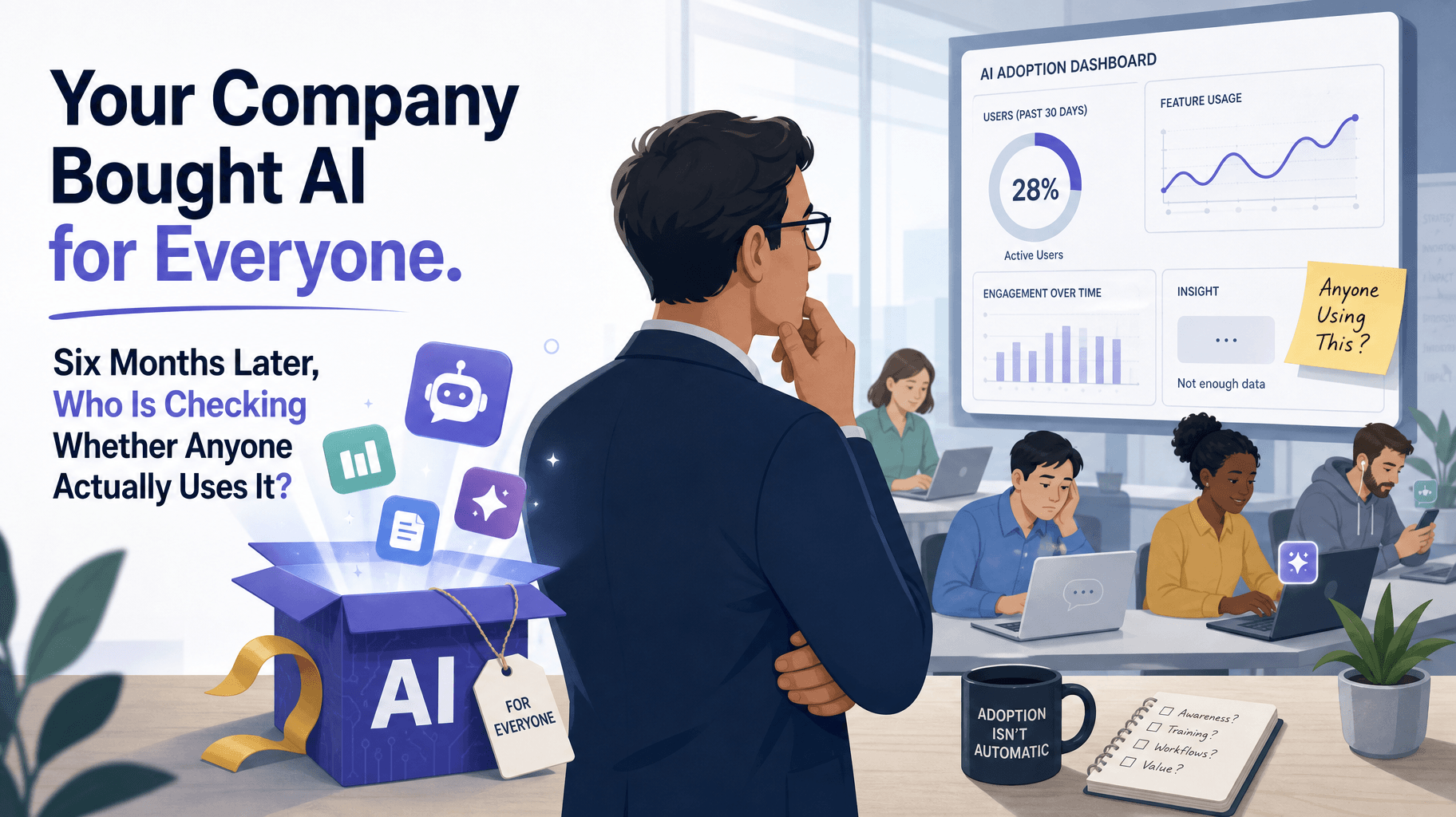
Six months ago, management decided that artificial intelligence was no longer something the company could afford to ignore. Competitors were talking about AI, employees were experimenting with new tools and almost every business conference seemed to include a presentation about automation and productivity. The company responded quickly. AI subscriptions were purchased for employees, new features were activated inside existing software and managers were encouraged to find ways to incorporate AI into everyday work. There was excitement at the beginning. Employees attended demonstrations, management discussed how many hours could potentially be saved and somebody even calculated how much additional work the company could handle if everyone became 20 per cent more productive. Six months later, however, a much less exciting question appears during a management meeting: is anyone actually using what the company paid for? The finance department can see subscription charges appearing every month, but management cannot clearly explain which tools are actively used, what work they have improved or whether the promised productivity gains have materialised. The company has successfully purchased AI, but purchasing technology and obtaining value from technology are two very different achievements.
AI Adoption Has Become a Management Question, Not Just a Technology Question
Singapore businesses are increasingly experimenting with artificial intelligence, but adoption is not uniform. In August 2026, the Ministry of Manpower reported that AI adoption remained significantly lower among smaller firms than among larger businesses, with 27.2 per cent of firms employing fewer than 200 workers adopting AI compared with 76.4 per cent among firms employing more than 500 workers. The figures illustrate something important for SMEs. The question is no longer simply whether AI exists or whether companies have heard about it. Businesses increasingly need to decide where AI genuinely improves their operations, how employees should use it and whether investments in AI produce meaningful results. A company can subscribe to sophisticated technology within minutes. Building useful habits around that technology can take considerably longer.
The Monthly Subscription Looks Small Until You Multiply It by Everyone
A single AI subscription may not look particularly expensive. Management sees a monthly price and thinks the productivity benefit only needs to save an employee a small amount of time to justify the cost. But companies rarely purchase only one piece of software. There may already be subscriptions for accounting, customer relationship management, cloud storage, project management, design, communication, cybersecurity, analytics and document management. AI capabilities are then added through separate tools or premium versions of existing platforms. Multiply those costs across 20, 50 or 100 employees and what looked like a collection of small monthly expenses becomes a meaningful annual technology budget. The issue is not that businesses should avoid software expenditure. The issue is that recurring costs are easy to forget because they leave the bank account quietly every month. Management may scrutinise a S$50,000 equipment purchase carefully while approving dozens of subscriptions that eventually cost the same amount without receiving the same level of review.
Having 50 Licences Does Not Mean You Have 50 Users
Imagine a company purchases AI access for 50 employees because management wants everyone to have the opportunity to use it. Six months later, actual behaviour may look very different from what was expected. Ten employees use the tool every day. Another ten use it occasionally. Fifteen tried it during the first month and gradually stopped. The remaining employees may have logged in once or never activated their accounts at all. Yet the company continues paying for all 50 licences. From an accounting perspective, the subscription expense is straightforward. From a management perspective, the more important question is whether the expenditure is producing sufficient value. A company should not assume that purchasing access automatically creates adoption.
The Employee Who Uses AI Every Day May Not Be the Employee Management Expected
Usage can also develop unevenly across departments. Management may purchase AI primarily for marketing but discover that finance uses it heavily to summarise documents, while the sales team barely touches it. Human resources may find several valuable use cases while operations considers the tool irrelevant to its work. This is not necessarily a problem. Technology often produces benefits in unexpected places. The mistake is assuming before implementation that every employee should use the same tool in the same way. A better approach is to observe where AI actually creates value and adjust licences, training and policies accordingly.
Low Usage Does Not Automatically Mean Employees Are Resistant to Technology
When management discovers that employees are not using an expensive system, the easiest explanation is often, “Staff don’t want to change.” Sometimes resistance is genuinely part of the problem, but there can be more practical reasons. Perhaps the tool does not fit the employee’s workflow. Perhaps using it requires copying information between multiple systems, which creates more work than it saves. Employees may not know which tasks are suitable for AI. They may have received a one-hour demonstration six months earlier but no practical guidance afterwards. Some may worry about putting company information into an external system. Others may have tried the technology, received inaccurate results and quietly returned to their old method. Before blaming employees for low adoption, management should understand why adoption is low.
A Demonstration Is Not the Same as Training
AI demonstrations can be impressive because presenters usually choose tasks that showcase the technology’s strengths. A document appears, a prompt is entered and seconds later the software produces a polished summary. Employees leave thinking the technology is amazing. The next morning, however, they face their actual work, which may involve messy spreadsheets, unusual customer requests, internal terminology and processes that the demonstration never covered. Employees need practical examples connected to their own responsibilities. A finance employee needs to understand how AI might assist with financial analysis without compromising confidential information. A salesperson needs examples relevant to customer research or communication. A manager may need help using AI to organise information without outsourcing judgement. Training becomes more valuable when it answers the question employees actually have: “How does this make my job easier today?”
Some Employees May Already Be Using AI Without the Company’s Official Tool
There is another possibility management should consider. The company purchases an approved AI platform, but employees continue using free tools they discovered independently because those tools feel easier or more familiar. From management’s perspective, official adoption looks low. In reality, AI usage may be happening extensively outside the systems the company monitors. This creates a different problem because employees may paste customer information, internal documents or commercially sensitive material into tools without understanding the organisation’s expectations regarding data. An unused corporate AI licence may therefore reveal more than wasted expenditure. It may indicate that the company’s official technology strategy does not match actual employee behaviour.
Shadow AI Can Grow Before Management Realises It Exists
For years, companies have worried about “shadow IT”, where employees use unapproved applications because official systems do not meet their needs. AI creates a similar challenge. An employee has a report due at 5 pm, discovers an AI tool that can help and starts using it without asking the IT department. If the result is useful, they use it again tomorrow. Soon several colleagues are doing the same thing. Nobody intended to create a governance problem. Employees were simply trying to work efficiently. The company therefore needs realistic policies that acknowledge how accessible AI has become. A policy that merely says “do not use AI” may be difficult to enforce if employees can access numerous tools through a web browser or personal device.
Productivity Should Be Measured in Outcomes, Not Excitement
The first month after an AI rollout can generate impressive stories. An employee says a task that previously took two hours now takes 20 minutes. Another employee produces a presentation in half the usual time. These examples are useful, but management should distinguish isolated successes from sustainable organisational productivity. Did the department actually process more work? Did turnaround times improve? Did employees spend fewer hours on repetitive tasks? Did customer response times improve? Did errors decline? Did operating costs change? These outcomes provide stronger evidence than simply counting how many employees say they have experimented with AI.
Saving 30 Minutes Is Valuable Only if the Time Goes Somewhere Useful
Suppose AI saves each employee 30 minutes per day. Across 50 employees, that sounds enormous. But what happens to the saved time? Employees may use it to complete additional valuable work, improve customer service, analyse information more deeply or leave work on time instead of working overtime. All of these can be legitimate benefits. Alternatively, the saved time may disappear into additional meetings, unnecessary reports or low-value tasks. Productivity improvements do not automatically convert into financial gains. Management needs to understand what employees do with the capacity technology creates.
Not Every AI Benefit Needs to Appear as Headcount Reduction
Companies sometimes evaluate AI using an overly narrow question: “How many employees can this replace?” That can lead management to overlook more realistic benefits. MOM reported in April 2026 that among firms adopting AI, 70.7 per cent reported improved worker productivity, while reported workforce outcomes included redesigning jobs and redeploying employees rather than simply widespread workforce reduction. AI may allow employees to handle more customers, reduce repetitive work, produce faster first drafts, improve research or spend more time on judgement-intensive tasks. A company can therefore receive significant value from AI even when headcount remains unchanged.
Faster Work Is Not Automatically Better Work
An employee who previously took three hours to prepare a report may now produce it in 45 minutes using AI. That sounds like an obvious improvement until management discovers that several figures were interpreted incorrectly. Productivity needs to consider quality as well as speed. If employees save two hours generating a document but managers spend another two hours correcting it, the organisation has not gained much. Worse, if inaccurate output reaches customers or influences management decisions, the cost of the mistake can exceed the time saved. AI performance should therefore be evaluated using both efficiency and reliability.
The Most Dangerous Output Is Often the One That Looks Completely Professional
One reason AI requires appropriate review is that incorrect output does not necessarily look incorrect. A badly written manual report may immediately attract attention. AI can produce polished paragraphs, convincing explanations and neatly structured analyses even when part of the underlying content is wrong. Employees may therefore become less sceptical precisely because the output looks professional. Companies should train employees to treat AI-generated work as something that may require verification rather than assuming presentation quality proves factual accuracy.
AI Should Assist Judgement, Not Quietly Replace Accountability
Imagine a manager asks an AI system whether a customer should receive a higher credit limit. The tool analyses information and recommends approval. If the customer later fails to pay, who was responsible for the decision? “The AI recommended it” is unlikely to be a satisfactory answer. Businesses need clear accountability. Technology can assist analysis, identify patterns and provide suggestions, but people remain responsible for important commercial decisions. This becomes especially important in finance, tax, accounting and other areas where incorrect information can create financial or compliance consequences.
Good AI Needs Good Data
AI systems are often presented as tools capable of finding insights hidden inside large volumes of information. But the usefulness of those insights depends on the quality of the information available. If customer records are incomplete, accounting categories are inconsistent and spreadsheets contain outdated information, AI can process the mess faster without necessarily making it more accurate. Businesses considering sophisticated AI analytics should therefore ask whether their underlying data is reliable enough to support the analysis. Technology cannot automatically repair years of inconsistent record keeping.
Your Accounting System May Reveal More About AI ROI Than the AI Dashboard
Technology vendors naturally provide statistics such as logins, prompts submitted and active users. Those numbers help measure adoption, but management should also examine financial and operational information. Has overtime decreased? Are external service costs lower? Has revenue per employee improved? Are projects completed faster? Have customer response times changed? Are error rates lower? Has the company avoided additional hiring because existing employees can handle more work? The objective is not to attribute every financial movement to AI. It is to connect technology investment with measurable business outcomes wherever reasonably possible.
A Licence Audit Can Be Surprisingly Valuable
One of the simplest exercises a business can conduct is a periodic review of software licences. List the tools the company pays for, how many licences exist, which employees have access and whether those accounts are actively used. Businesses often discover former employees who still occupy paid licences, duplicate tools performing similar functions and premium subscriptions used only for basic features available on cheaper plans. AI makes this exercise more important because many new services use recurring subscription models. Cutting unused licences does not require abandoning digital transformation. It simply ensures the company pays for technology people actually use.
Duplicate AI Tools Can Quietly Multiply
One department subscribes to an AI writing platform. Another purchases a productivity suite that already includes similar capabilities. The design team has another AI subscription. Customer service purchases an automation platform. Management later approves an enterprise AI tool intended for everyone. Each decision may have been reasonable individually, but nobody reviewed the technology portfolio collectively. The company can end up paying several vendors for overlapping capabilities. Periodic review helps identify whether consolidation could reduce cost and simplify training.
The Cheapest Tool Is Not Necessarily the Best Tool
Cost control should not become an exercise in automatically cancelling expensive subscriptions. A S$50 monthly tool that saves an employee ten hours may be far more valuable than a S$10 tool nobody uses. Management needs to consider value rather than price alone. The objective is not to minimise technology expenditure. It is to maximise useful output from the expenditure the company chooses to make.
Usage Data Needs Context
Suppose management discovers one employee uses the AI system 500 times per month while another uses it only five times. It may be tempting to conclude that the first employee is obtaining 100 times more value. That could be completely wrong. The second employee might use AI five times to analyse complex documents that would otherwise require hours of work, while the first employee uses it repeatedly for minor wording changes. Usage statistics should therefore be interpreted alongside the nature of the work. Management needs enough context to understand whether activity corresponds to value.
Some Departments May Not Need AI at All
Technology strategies sometimes become ideological. Management decides the company must become “AI-first,” and suddenly every department is expected to find an AI use case whether one exists or not. This can create waste. If a process already takes five minutes, has almost no errors and costs very little, automating it may produce minimal benefit. Resources may be better directed towards areas with genuine bottlenecks. Successful digitalisation does not require using AI everywhere. It requires using appropriate technology where it solves a meaningful problem.
Start With Problems, Not Features
A software vendor demonstrates 50 impressive features and management begins asking where each feature can be used. A better approach is often the opposite. Identify problems first. Which tasks consume excessive employee time? Where are customers waiting too long? Which processes produce frequent errors? What information takes too long to analyse? Which repetitive activities frustrate employees? Once the business understands the problem, it can evaluate whether AI, conventional automation, process redesign or simply better training provides the best solution.
Sometimes the Best AI Project Is Not an AI Project
A finance team spends hours manually entering information from one spreadsheet into another. Management immediately considers AI automation. But perhaps the two systems can already integrate directly. A customer-service team repeatedly answers the same questions, so management considers an AI chatbot. Perhaps the website simply needs clearer information. A manager spends hours combining monthly reports, so the company considers AI analysis. Perhaps the reports themselves should be redesigned. Technology should not become an expensive way of avoiding simpler process improvements.
Automating a Bad Process Can Make the Bad Process Faster
Imagine an expense approval process where employees submit information to a manager, who forwards it to finance, which re-enters it into a spreadsheet before entering it again into the accounting system. AI could potentially automate parts of this workflow. But before doing so, management should ask why the information moves through so many stages in the first place. If two steps can be removed entirely, process redesign may create more value than sophisticated automation. AI works best when applied to processes that already make sense.
Management Needs an Owner for Every Significant Technology Investment
One reason software subscriptions remain unused is that nobody owns the outcome after purchase. IT installs the system. Finance pays the invoices. HR organises initial training. Employees receive access. Then everyone assumes somebody else is responsible for adoption. Six months later, nobody can answer whether the investment succeeded. Significant technology projects should have an accountable owner who monitors usage, gathers feedback, identifies obstacles and evaluates results. Ownership does not require a new department. It requires clarity about who is responsible for ensuring the company receives value.
Finance Should Ask Questions Without Becoming the Department That Says No
Finance teams are well positioned to identify recurring software expenditure because they see invoices and subscription payments. Their role should not necessarily be to reject every new technology request. Instead, finance can ask useful questions. How many licences are required? What problem does the tool solve? Is another system already providing the same function? How will management know whether the investment works? When should the subscription be reviewed? These questions improve decision-making without preventing experimentation.
Small Experiments Can Be Better Than Company-Wide Rollouts
A business does not always need to purchase 100 licences immediately. It may begin with a smaller group of employees whose work is particularly suitable for the technology. Management can observe how they use it, identify risks, collect productivity evidence and develop practical guidelines before expanding access. This approach reduces wasted expenditure and allows lessons from early users to improve the broader rollout.
Employees Should Help Identify the Best Use Cases
Senior management may understand strategy, but employees often understand operational friction better because they experience it every day. Ask them which repetitive tasks consume time, which documents are difficult to prepare and where information is repeatedly re-entered. Employees may identify useful AI applications management never considered. Involving staff also makes adoption more practical because the technology is being applied to problems they genuinely want solved rather than imposed as another corporate initiative.
Incentives Can Accidentally Encourage Bad AI Usage
If management tells every employee, “You must use AI every day,” people will find ways to satisfy the metric even when AI adds little value. If managers are evaluated on the number of AI projects launched, they may create unnecessary projects. Adoption targets need to focus on outcomes rather than activity. A department that uses AI for one high-value process may produce more benefit than another that uses it constantly for trivial tasks.
Employees Need Permission to Say the Tool Is Not Working
Technology projects become expensive when nobody wants to tell senior management that the investment was unsuccessful. Perhaps the CEO championed the AI rollout enthusiastically, so employees continue pretending it is useful. Managers report positive adoption because they do not want their department to appear resistant to change. Meanwhile, employees quietly return to their old processes. Management needs honest feedback. Cancelling or changing a tool that does not deliver value is not failure. Continuing to pay for it indefinitely because nobody wants to admit the original decision was wrong is much worse.
AI Governance Does Not Need to Be a 100-Page Policy
Smaller businesses may hear “AI governance” and imagine complicated committees, lawyers and endless documentation. Practical governance can begin with straightforward rules. Which tools are approved? What types of company information should not be entered? Which outputs require human review? Who remains responsible for decisions? How should employees handle confidential customer data? Who should be contacted when they are unsure? Clear principles are more useful than a long policy nobody reads.
Confidential Financial Information Deserves Particular Care
Finance employees may see enormous potential in AI because their work involves documents, spreadsheets, reports and analysis. But those materials can also contain sensitive information about customers, employees, salaries, suppliers, bank accounts and company performance. Employees should understand what information can be used with approved systems and what restrictions apply. Convenience should not cause staff to paste confidential financial information into tools without considering how that information is handled.
Human Review Becomes More Important as Automation Increases
This may sound contradictory. If technology is more capable, why should humans review it? Because automation changes the nature of human work. Employees may spend less time manually producing information and more time checking exceptions, interpreting results and making decisions. The review process can become more valuable because one automated system may process thousands of transactions. A small error in its configuration can therefore affect far more transactions than a single manual mistake.
Internal Controls Need to Evolve With New Technology
Companies often build controls around traditional processes. One employee prepares a document, another checks it and a manager approves it. When AI enters the workflow, the process may change substantially. Perhaps AI now prepares the first draft or automatically classifies information. Management should reconsider where errors could arise and what review remains appropriate. Existing controls should not simply be copied onto a new process without understanding how the risks have changed.
An Independent Review Can Reveal What Management Cannot See
Management teams naturally become accustomed to their own processes. A workflow that seems normal internally may contain unnecessary duplication, weak controls or unclear responsibilities that an independent reviewer notices immediately. Professional advisers such as Lee & Hew Public Accounting Corporation work with businesses across areas including audit, internal audit, accounting and advisory services. As companies introduce more digital tools into financial and operational processes, periodically reviewing whether systems, controls and responsibilities still make sense can help management understand whether technology has actually strengthened the business rather than simply making it look more modern.
Six Months Is a Good Time to Ask Uncomfortable Questions
The first week after implementation is usually too early to judge a new tool because employees are still learning. Waiting three years is too long if the company is paying for something nobody uses. A six-month review can provide enough time for initial excitement to disappear and real behaviour to emerge. Which employees are active? Which departments obtained value? What problems remain? Which licences can be removed? What additional training is needed? Are there security or governance concerns? Should the rollout expand, shrink or change direction? These questions turn technology adoption into an ongoing management process rather than a one-time purchase.
The Review Should Not Become a Witch Hunt
If management announces, “We are checking who hasn’t used AI enough,” employees may immediately begin generating unnecessary activity to protect themselves. The objective should be understanding rather than punishment. Low usage might reveal poor training, irrelevant features or a mismatch between the technology and the employee’s work. Management should be interested in why adoption differs and what that tells the company about future investment decisions.
Measure What Changed, Not Just What Was Purchased
At the end of the review, management should be able to describe outcomes. Perhaps the sales team prepares proposals faster. Finance reduced manual data processing. Customer service responds more quickly. Marketing increased content output without additional headcount. Managers spend less time preparing routine summaries. Alternatively, perhaps nothing meaningful changed. Both findings are useful. Evidence that a technology investment failed can prevent the company from spending even more money expanding it.
AI ROI Is Ultimately a Business Question
Return on investment does not belong only to finance. The department using the tool understands operational benefits, IT understands technical considerations and management understands strategic objectives. Evaluating AI therefore requires collaboration. The company should compare costs with relevant improvements while recognising that some benefits, such as employee satisfaction or faster customer service, may not translate neatly into a single dollar figure. The objective is not perfect measurement. It is enough evidence to make an informed decision about whether to continue investing.
Digital Transformation Should Include Digital Housekeeping
Companies love launching new technology because launches feel like progress. Cancelling unused subscriptions, cleaning data, consolidating software and documenting processes are less exciting. Yet these activities can create significant value. As the company’s technology environment expands, periodic housekeeping prevents unnecessary costs and complexity from accumulating. A modern business is not necessarily the company with the most software. It is the company that uses technology effectively.
The Goal Is Not Maximum AI Usage
This distinction matters. If management’s objective is maximum AI usage, employees will use AI whether or not it improves their work. The better objective is maximum useful value. Some employees may use AI dozens of times every day. Others may use it twice per month for highly valuable tasks. Some may have no meaningful use for it at all. A successful strategy accommodates these differences rather than treating adoption as a competition.
The Best Technology Can Eventually Become Invisible
When technology genuinely improves a process, employees eventually stop talking about the technology itself. They simply complete the work faster or better. Nobody celebrates every time accounting software calculates a total correctly because the software has become part of normal operations. AI may eventually follow the same path. The strongest implementations may be those where employees no longer say, “Look, we are using AI,” because the tool has become a practical part of how useful work gets done.
Conclusion: The Question Is No Longer Whether Your Company Has AI
Six months ago, management asked:
“Should we buy AI for everyone?”
Today, the more useful questions are different.
Who actually uses it?
What are they using it for?
Which tasks became faster?
Did quality improve?
Which licences are sitting unused?
Are employees using unapproved alternatives?
What information are they putting into those tools?
Who checks important outputs?
Did the company save money?
Did employees gain useful capacity?
Did customers receive better service?
Would the company notice any difference if the subscription disappeared tomorrow?
That last question can be surprisingly powerful.
If a S$50,000 annual software subscription disappeared tomorrow and nobody’s work changed, management has probably learned something important.
If removing it would immediately make employees slower, customers wait longer and important processes harder to complete, the company has learned something equally valuable.
AI adoption should not be measured by how many licences the company purchased, how many employees attended training or how many times management mentions artificial intelligence in meetings.
It should be measured by what changed.
Singapore businesses are clearly moving towards greater AI adoption, although adoption remains much higher among larger firms than smaller ones. The opportunity for SMEs is therefore not simply to copy larger companies by purchasing more technology. It is to be selective about where technology creates genuine value, build practical employee capability around those use cases and measure whether the expected benefits actually appear.
Buying AI is easy.
Creating an AI policy is manageable.
Sending employees for training is straightforward.
Putting “AI transformation” into next year’s business plan is even easier.
The difficult part begins afterwards.
Management has to determine whether the technology actually made the company better.
That means looking beyond the impressive demonstration.
Beyond the number of licences.
Beyond the login statistics.
Beyond employees saying, “Yes, I use it sometimes.”
Look at the business.
Did work become faster?
Did errors decline?
Did employees gain capacity?
Did customers benefit?
Did costs improve?
Did decisions become better?
If the answer is yes, the company may have found an AI investment worth expanding.
If the answer is no, management should be willing to investigate why.
Perhaps employees need better training.
Perhaps the wrong tool was selected.
Perhaps the process needs to be redesigned.
Perhaps only 20 of the 50 licences are necessary.
Or perhaps the company never had a problem that required AI in the first place.
There is nothing wrong with discovering that.
The expensive mistake is continuing to pay simply because cancelling the subscription would mean admitting the original excitement did not become real value.
So six months after buying AI for everyone, management should not ask:
“Are we an AI company yet?”
Ask something much simpler:
“What became better because we bought it?”
If nobody in the meeting can answer clearly, it may be time to open the subscription list.