
Three Numbers Can Create More Confusion Than Business Owners Expect
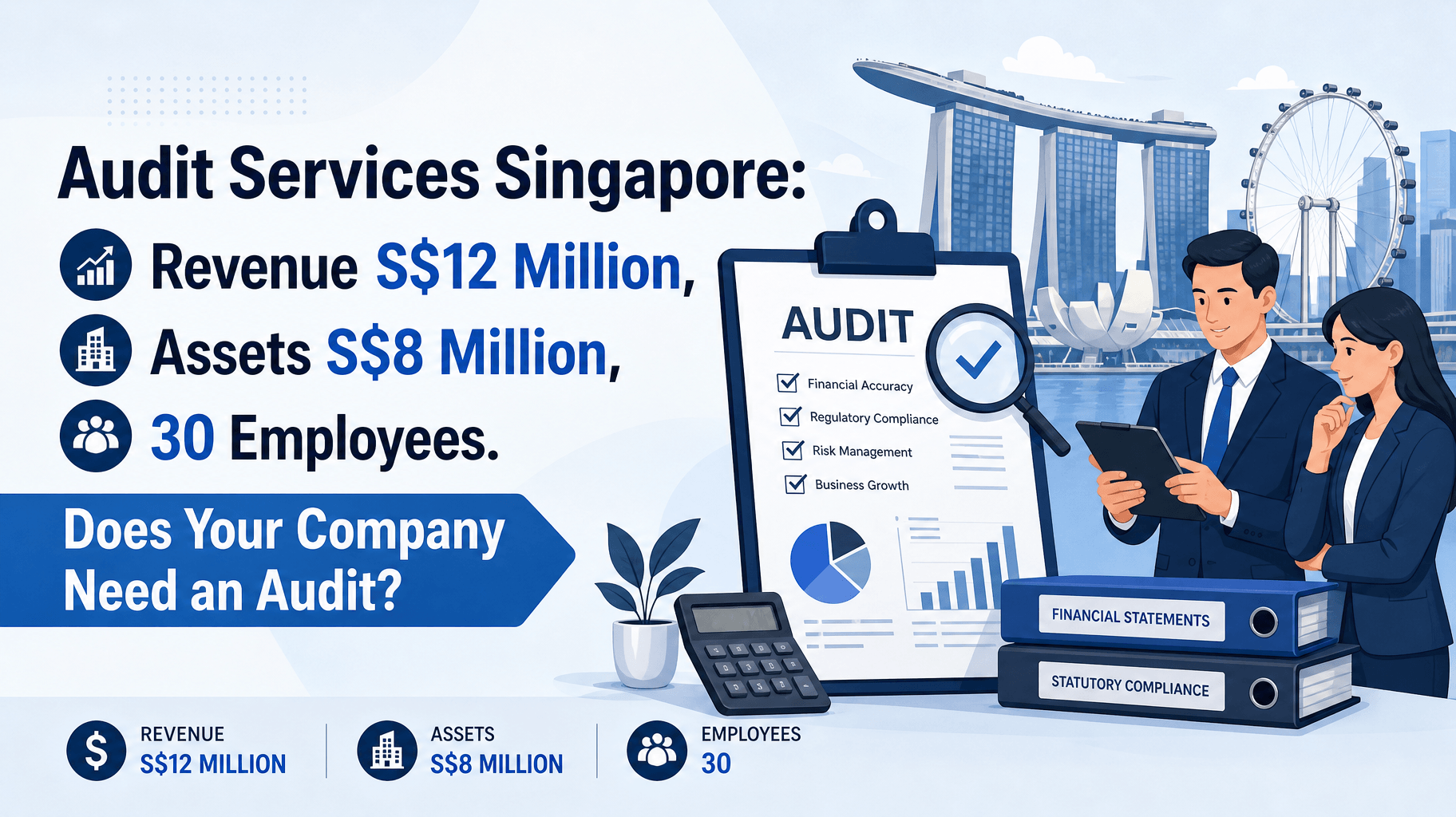
Your Singapore company has just completed another strong financial year. Annual revenue reached S$12 million, total assets were S$8 million and the business employed 30 full-time employees at year-end. Management knows that Singapore’s small-company audit exemption uses thresholds involving revenue, assets and employees, so someone in the finance meeting asks what sounds like a simple question: “Revenue already above S$10 million. Does this mean we definitely need an audit now?” At first glance, the answer may seem obvious. S$12 million is above S$10 million, therefore the company must have crossed the audit threshold. But Singapore’s current small-company audit exemption is not based on revenue alone. A private company generally needs to satisfy at least two out of three quantitative criteria for the immediate past two consecutive financial years: annual revenue of S$10 million or less, total assets of S$10 million or less and 50 employees or fewer. That means a company with S$12 million of revenue, S$8 million of assets and 30 employees may still satisfy two of the three quantitative criteria. The actual answer therefore depends on the company’s circumstances over the relevant years and whether other requirements, including group considerations where applicable, are met.
Revenue Above S$10 Million Does Not Automatically Answer the Question
The misunderstanding usually begins because people casually refer to a “S$10 million audit threshold.” That phrase makes it sound as though Singapore has one single line that determines whether a company must be audited. In reality, the current small-company framework uses three quantitative measures rather than one. A company can exceed the S$10 million revenue criterion while remaining within the S$10 million asset criterion and the 50-employee criterion. If it satisfies at least two of the three required quantitative criteria for the relevant periods and meets the other conditions, it can potentially remain within the small-company framework. This is why businesses searching for audit services Singapore should avoid deciding their audit status from revenue alone. A single number can be important without being decisive.
Start With the Three Criteria Separately
Using our example, the company reports annual revenue of S$12 million. That means it does not meet the revenue criterion of S$10 million or less for that particular year. Its total assets are S$8 million, which is within the S$10 million asset threshold. It also has 30 employees, which is below the maximum of 50. Looking only at those three numbers for one year, the company meets two out of three quantitative tests: assets and employees. This immediately demonstrates why the headline revenue figure cannot be used in isolation. However, the analysis does not stop there, because an established company generally needs to consider the immediate past two consecutive financial years rather than looking only at the latest period.
The Two-Year Requirement Is Where Many Owners Get Caught
For companies that are not newly incorporated, ACRA’s current framework generally requires the company to meet at least two of the three quantitative criteria for the immediate past two consecutive financial years. This means management cannot simply take the latest financial statements, check two boxes and assume the answer is final. Suppose your company had S$9 million of revenue, S$7 million of assets and 28 employees in the previous year, followed by S$12 million of revenue, S$8 million of assets and 30 employees this year. It would have met all three quantitative criteria in the earlier year and two out of three in the later year. If the other conditions are satisfied, the company may still fit within the small-company test. The analysis needs to reflect both years rather than only the year in which revenue first exceeded S$10 million.
Crossing One Threshold Is Not the Same as Losing Small-Company Status
This distinction is particularly important for growing SMEs. A company may cross S$10 million in revenue during a strong year while still remaining relatively modest in assets and headcount. Singapore’s framework recognises that company size cannot necessarily be captured by sales alone. A software company could generate S$15 million with 25 employees and limited physical assets, while a capital-intensive business could have S$8 million of revenue but substantially more assets. The two-out-of-three structure therefore takes multiple dimensions of company size into account. Business owners should not interpret crossing one threshold as an automatic compliance switch without reviewing the complete test.
The Company Must Also Be a Private Company
The quantitative criteria are not the only requirement. ACRA states that the small-company audit exemption applies where the company is a private company in the financial year and meets the relevant quantitative criteria. Therefore, even perfect numbers do not answer the question without considering the company’s legal status. This is another reason online discussions that focus solely on “revenue below S$10 million” are incomplete. Eligibility is based on the framework as a whole, not merely one arithmetic test.
Newly Incorporated Companies Have a Different Starting Point
The two-year analysis also has an important qualification for newly incorporated companies. ACRA explains that a company less than two years old can assess qualification using the criteria for the current financial year, with the specific treatment depending on whether it is the first or second financial year. This means a newly formed company that grows extraordinarily quickly may not apply the test in exactly the same way as a mature business with ten years of financial history. Businesses should therefore be careful when copying another company’s audit analysis because incorporation date and financial history can matter.
The Example Becomes More Complicated if the Company Belongs to a Group
Now imagine our S$12 million revenue company is not independent. It is a Singapore subsidiary of a regional group. Perhaps the Singapore entity has S$8 million of assets and 30 employees, but its parent company owns several businesses in Malaysia, Indonesia and Australia. In that situation, looking only at the Singapore subsidiary’s individual numbers is not enough. Under the current rules, a company that belongs to a group needs the Singapore company itself to qualify as a small company and the entire group to satisfy at least two of the three quantitative criteria on a consolidated basis for the relevant two consecutive years. This can produce a completely different result even when the local subsidiary appears small.
A Tiny Singapore Subsidiary Can Belong to a Very Large Group
Consider a Singapore subsidiary with only S$3 million in revenue, S$2 million of assets and 10 employees. If it were an independent private company, the numbers might appear comfortably within the small-company thresholds. But if it belongs to a multinational group with hundreds of millions of dollars in revenue and assets, the consolidated small-group requirements become relevant. This is why business owners should never assume that “our Singapore company is small” automatically means “we are audit exempt.” Group membership can change the analysis significantly.
Foreign Group Entities Still Matter
Another point that can surprise management is that the group analysis is not limited only to Singapore companies. ACRA’s guidance notes that the entire group, including foreign entities, is considered when assessing the relevant small-group quantitative criteria. A Singapore subsidiary therefore cannot ignore its overseas parent or sister companies simply because those businesses are not incorporated locally. This matters increasingly as Singapore SMEs expand regionally and create overseas subsidiaries or become part of international corporate structures.
Not Preparing Consolidated Financial Statements Does Not Automatically Avoid Group Rules
Some owners may think that if their company does not prepare consolidated financial statements, the small-group concept should not apply. ACRA’s guidance specifically explains that whether an entity is part of a group is determined in accordance with the applicable accounting standards, and a company owned by another company may still need to assess whether it belongs to a small group even if it does not prepare or file consolidated financial statements itself. The legal and accounting relationship matters more than whether management happens to produce a consolidation package internally.
Once You Qualify, You Do Not Reassess From Zero Every Single Year
Another useful feature of the framework is how small-company status is maintained. ACRA explains that once a company qualifies as a small company, it generally remains qualified in subsequent financial years unless it ceases to be a private company or fails to meet at least two of the three quantitative criteria for the immediate past two consecutive financial years. This prevents a single unusual year from automatically causing status to flip immediately in every circumstance. For growing businesses, however, sustained expansion can eventually cause the company to fall outside the criteria, which is why management should monitor the trend rather than wait until the last minute.
Revenue Growth Usually Arrives Before the Compliance Conversation
Many companies focus intensely on crossing sales milestones but only think about the audit implications afterwards. When revenue approaches S$10 million, management is usually concentrating on hiring, customers, inventory, expansion and cash flow. Nobody is celebrating by opening ACRA’s audit exemption page. Then year-end accounts arrive and the finance team suddenly realises that the company has changed materially from the business it was several years ago. Monitoring the relevant criteria before year-end allows management to budget for professional fees, organise financial records and plan timelines instead of discovering audit requirements when filing deadlines are already approaching.
Assets Can Grow Faster Than Management Notices
Revenue attracts attention because it appears in sales reports every month. Total assets can be much less visible to business owners even though the S$10 million asset threshold is one of the current quantitative criteria. A growing company may accumulate receivables, inventory, cash, equipment or other assets until the balance sheet becomes much larger than management realises. A business might therefore remain below S$10 million of revenue while crossing the asset threshold. Companies near the audit exemption limits should review the balance sheet alongside the profit and loss statement rather than watching only sales.
Employee Count Sounds Simple but Still Has a Definition
The employee criterion is 50 employees or fewer, based on the number of full-time employees at the end of the financial year. This sounds straightforward, but fast-growing companies should still monitor it rather than relying on a rough estimate from management. A company with 48 employees planning several hires near year-end may find the number more relevant than it previously seemed. Different businesses also scale very differently. A manpower-intensive company can cross the employee threshold while remaining comfortably below the revenue and asset limits, whereas a technology company may produce substantial revenue with a small workforce.
Two Businesses With S$12 Million Revenue Can Have Different Audit Outcomes
Imagine Company A has S$12 million in revenue, S$8 million in assets and 30 employees. Company B also has S$12 million of revenue but has S$15 million in assets and 65 employees. Both owners tell their friends, “My company revenue is S$12 million.” Yet the two businesses look completely different under the quantitative criteria. Company A meets the asset and employee thresholds, while Company B exceeds all three. The second company may therefore face a very different audit-exemption position, assuming the relevant two-year and other conditions are considered. This example shows why revenue alone cannot be used as shorthand for the entire framework.
Another Company Could Have S$9 Million Revenue and Still Fail the Test
The opposite can happen too. Imagine Company C has only S$9 million of revenue but S$14 million of assets and 70 employees. It meets the revenue criterion but exceeds the asset and employee criteria. Looking only at sales, management might think the company is safely below “the S$10 million threshold.” In reality, it meets only one of the three quantitative criteria for that year. This is why the phrase “audit threshold” can be misleading when used without explaining the full two-out-of-three structure.
Singapore Is Reviewing These Thresholds in 2026
The topic is particularly timely because ACRA announced on 26 February 2026 that it is reviewing Singapore’s audit exemption framework. The review includes whether the current S$10 million annual revenue and S$10 million total asset thresholds should be increased. ACRA is also exploring whether subsidiaries could qualify for audit exemption under specific conditions even when the group does not meet the exemption thresholds on a consolidated basis. The review reflects how businesses have grown since the framework was introduced and how other jurisdictions have updated their own thresholds.
The Current Rules Still Matter Until Changes Actually Take Effect
Business owners should be careful not to read headlines about the review and assume that a higher threshold already applies. ACRA has announced a review and consultation, but companies must continue to assess their current obligations using the requirements actually in force unless and until changes take effect. This distinction is especially important when planning a current-year audit. A proposed increase in the threshold does not automatically eliminate an audit requirement that exists under today’s framework.
Why Is ACRA Reviewing the Framework Anyway?
ACRA stated that average company assets and revenue have grown since the framework was introduced in 2015, while jurisdictions including Australia, the United Kingdom, New Zealand and Malaysia have also increased their revenue and asset thresholds. The review is therefore partly about whether the framework remains appropriately calibrated for modern business conditions. The policy challenge is balancing compliance costs for smaller companies against the governance and assurance benefits associated with audits. For SMEs, the review could eventually affect how many companies qualify for exemption, but the outcome should not be anticipated before final changes are confirmed.
Audit Exemption Does Not Mean Accounting Exemption
This is one of the most important misunderstandings to address. Even if our hypothetical S$12 million revenue company qualifies for audit exemption, it still needs proper accounting records and financial statements in accordance with applicable requirements. ACRA explicitly states that companies must continue to keep proper accounting records and prepare financial statements according to prescribed accounting standards regardless of changes arising from the exemption review. Audit exemption therefore removes the statutory audit requirement where applicable. It does not mean the company can stop producing reliable financial information.
Directors Still Have Financial Reporting Responsibilities
ACRA’s guidance on directors’ financial reporting duties states that directors must present financial statements that comply with prescribed accounting standards and ensure that those financial statements give a true and fair view of the company’s performance and position. If the company is audit exempt, it can present unaudited financial statements; if it is not exempt, audited financial statements are required. The responsibility for proper financial reporting therefore remains with directors regardless of whether an external audit is statutorily required.
“Unaudited” Does Not Mean “Approximate”
The word unaudited sometimes creates the wrong impression. An owner may hear “audit exempt” and conclude that the accounts can now be prepared with less discipline because nobody will independently check them. That would be a mistake. Management still relies on financial statements for decisions, tax filings, financing and shareholder reporting. Banks or investors may also review them. An inaccurate receivables balance remains inaccurate whether an auditor is appointed or not. Audit exemption changes the independent assurance requirement, not the importance of getting the underlying accounts right.
Your Bank May Still Care About Audited Accounts
Statutory exemption answers one legal question: whether the Companies Act requires the company to undergo the audit under the relevant framework. It does not automatically determine what every lender, investor or commercial counterparty may request. A bank considering financing may ask for particular financial information depending on the facility and circumstances. Investors may seek independently audited historical financial statements before committing capital. A parent company may have group reporting requirements. Therefore, even where statutory exemption exists, management should consider whether other stakeholders create a commercial need for an audit.
Shareholders Can Still Have Something to Say
ACRA’s 2026 review announcement expressly states that shareholders will retain the right to require an audit if they hold at least 5% of the total issued shares of the company. This is an important reminder that statutory exemption does not necessarily mean management alone determines whether an audit occurs. Minority shareholders may value independent assurance over financial statements, particularly where they are not directly involved in day-to-day operations.
Audit Exemption and Financial Statement Filing Are Different Questions
ACRA’s current guidance also states that the small-company criteria do not change the company’s financial statement filing requirements. This is another area where business owners can become confused because audit, preparation and filing are often discussed together. A company may be audit exempt and still have financial statement filing obligations based on the applicable framework. Management should therefore avoid treating “audit exempt” as a universal exemption from every financial reporting requirement.
An Audit Can Still Be Voluntary
A company that qualifies for statutory exemption is not prohibited from obtaining an audit if management or stakeholders believe one is useful. There can be situations where independent assurance supports financing, shareholder confidence, preparation for investment or a planned sale. Whether the cost is worthwhile depends on the company’s circumstances. The important distinction is that “not required” and “not useful” are different statements. Businesses should make the decision according to their commercial needs rather than assuming exemption automatically makes an audit pointless.
Growing Companies May Need Independent Assurance Before the Law Requires It
Imagine a company remains technically audit exempt but is preparing for institutional investment. Management may want several years of independently audited financial information available before negotiations begin. Another company may be planning a sale to a larger group. A third may be negotiating substantial bank financing. In these situations, the value of an audit is not necessarily driven by statutory requirements. It may come from the expectations of people outside the existing management team who need confidence in the financial statements.
The First Audit Can Be Harder if Records Were Never Designed for One
A company that has been audit exempt for years may eventually grow out of the exemption. If management treated the exemption as a reason to maintain weak documentation, the first audit can become unnecessarily difficult. Old balances may lack explanations, fixed asset registers may be incomplete and supporting records may be inconsistent. Businesses approaching the thresholds can reduce this risk by maintaining good financial discipline before an audit becomes mandatory. Audit readiness is much easier to build gradually than reconstruct retrospectively.
Revenue S$12 Million May Signal More Than an Audit Question
Even if our hypothetical company still satisfies the small-company quantitative criteria through assets and employee count, crossing S$12 million in revenue tells management something important: the business is growing. Transaction volumes may have increased, customer balances may be larger and more employees may be making purchasing decisions. The financial processes that worked at S$3 million of revenue may no longer be suitable at S$12 million. The audit-exemption analysis therefore provides a useful opportunity to review the finance function itself rather than focusing only on whether an auditor must be appointed.
A Bigger Business Usually Needs Better Internal Controls
As the company grows, one person may no longer be able to monitor everything personally. Supplier creation, payment approvals, customer credit, bank access and financial reporting need clearer responsibilities. This does not mean building the bureaucracy of a listed multinational. Controls should remain proportionate to the business. But a S$12 million company with 30 employees usually faces larger financial exposures than it did when revenue was S$2 million. Management should ensure internal processes have grown alongside those exposures.
A Bigger Business Also Needs Better Monthly Information
Owners of small companies often manage successfully using sales reports and bank balances. As the company approaches eight-figure revenue, those indicators become less sufficient. Management may need timely information about gross margin, overdue receivables, cash flow, department expenditure and customer concentration. Whether or not the company is statutorily audited, reliable financial reporting becomes more valuable because decisions are larger and mistakes become more expensive.
Do Not Wait Until Filing Season to Determine Audit Status
Companies near the thresholds should assess their position before deadlines create urgency. Review the last two financial years. Check revenue, assets and employee numbers. Confirm whether the company belongs to a group. Understand whether the group meets the consolidated criteria. Consider whether any upcoming change in ownership or corporate structure affects the analysis. Businesses seeking audit services Singapore can also discuss their circumstances with an appropriate professional adviser rather than relying on assumptions made from one headline number.
Keep Evidence of How the Assessment Was Made
Good governance also means documenting why management concluded that the company qualifies or does not qualify for audit exemption. Financial statements provide the revenue and asset information, while employee records support the headcount. Corporate structure information helps identify whether group requirements apply. This makes the decision easier to revisit later and reduces the risk that a future finance employee needs to reconstruct management’s reasoning from memory.
The Answer Can Change as the Business Changes
Suppose our S$12 million revenue company continues growing. Next year revenue reaches S$15 million, assets rise to S$11 million and employees increase to 45. The company now exceeds both revenue and asset thresholds while remaining within the employee criterion. If the pattern persists across the relevant periods, its status can eventually change. A business should therefore treat audit-exemption assessment as something to monitor as part of financial compliance rather than a one-time conclusion made when the company was incorporated.
Acquisitions Can Change the Answer Faster Than Organic Growth
A company may remain within the thresholds for years and then acquire another business. Suddenly, group requirements apply or consolidated revenue and assets increase substantially. Management may be focused on integrating employees and customers while overlooking financial reporting implications. This is particularly relevant for fast-growing SMEs using acquisitions as part of their expansion strategy. Corporate changes can alter audit considerations even when the original operating business itself did not change dramatically.
Selling the Company Can Also Make Historical Audits More Relevant
Even when statutory audit is not required, a future buyer may want confidence in historical financial information. During due diligence, unexplained old balances or inconsistent accounting records can create questions that are expensive to answer several years later. Maintaining strong financial reporting therefore has long-term value independent of today’s audit exemption status. Good records support management now and make future financing, investment or sale processes easier.
The Cheapest Answer Is Not Always “Avoid the Audit”
Businesses naturally care about compliance costs, and ACRA’s current review explicitly seeks to balance governance oversight with reducing costs for smaller companies. But management should avoid thinking about audits purely as an expense to eliminate. Where an audit is not required and provides little commercial benefit, exemption can clearly reduce administrative burden. In other cases, independent assurance may support broader business objectives. The correct decision depends on what the company and its stakeholders actually need.
Professional Advice Matters Most Near the Boundary
A company with S$1 million of revenue, S$500,000 of assets and five employees has little ambiguity about the quantitative limits. A company with S$12 million revenue, S$8 million assets and 30 employees deserves more careful analysis because one threshold has already been exceeded and future growth may change the position. Group structures make the question more complicated again. This is where professional audit services Singapore providers can help businesses understand their current obligations and plan for upcoming changes.
Conclusion: S$12 Million Revenue Does Not Automatically Mean “Audit Required”
Return to the example.
Revenue: S$12 million.
Assets: S$8 million.
Employees: 30.
If management looks only at revenue, the answer seems obvious:
“We crossed S$10 million, so we definitely need an audit.”
But under Singapore’s current small-company framework, the analysis is not based on revenue alone.
The company fails the revenue criterion for that year.
It still meets the asset criterion.
It still meets the employee criterion.
That means it satisfies two out of the three quantitative criteria for that year.
For an established company, however, the relevant immediate past two consecutive financial years also need to be considered, alongside the requirement that the company be private. If the company belongs to a group, both the company and the group requirements become relevant.
So the correct answer is not simply:
S$12 million revenue = audit.
Nor is it automatically:
Two criteria met this year = definitely exempt.
The answer depends on the complete circumstances.
And in 2026 there is another layer: ACRA is reviewing whether the current revenue and asset thresholds should eventually be increased and whether the treatment of certain subsidiaries should change. Those proposals are important to follow, but businesses should continue to apply the current rules until any changes take effect.
At Audit Services Singapore, businesses can seek professional audit support and guidance as their financial reporting requirements become more complex. For companies approaching the current thresholds, early assessment can help management avoid both unnecessary panic and last-minute compliance surprises.
The best question for management is therefore not:
“Did our revenue cross S$10 million?”
It is:
“Looking at revenue, assets, employees, the previous two years and our group structure, what is our actual audit status?”
That is the question Singapore’s current framework is designed to answer.