
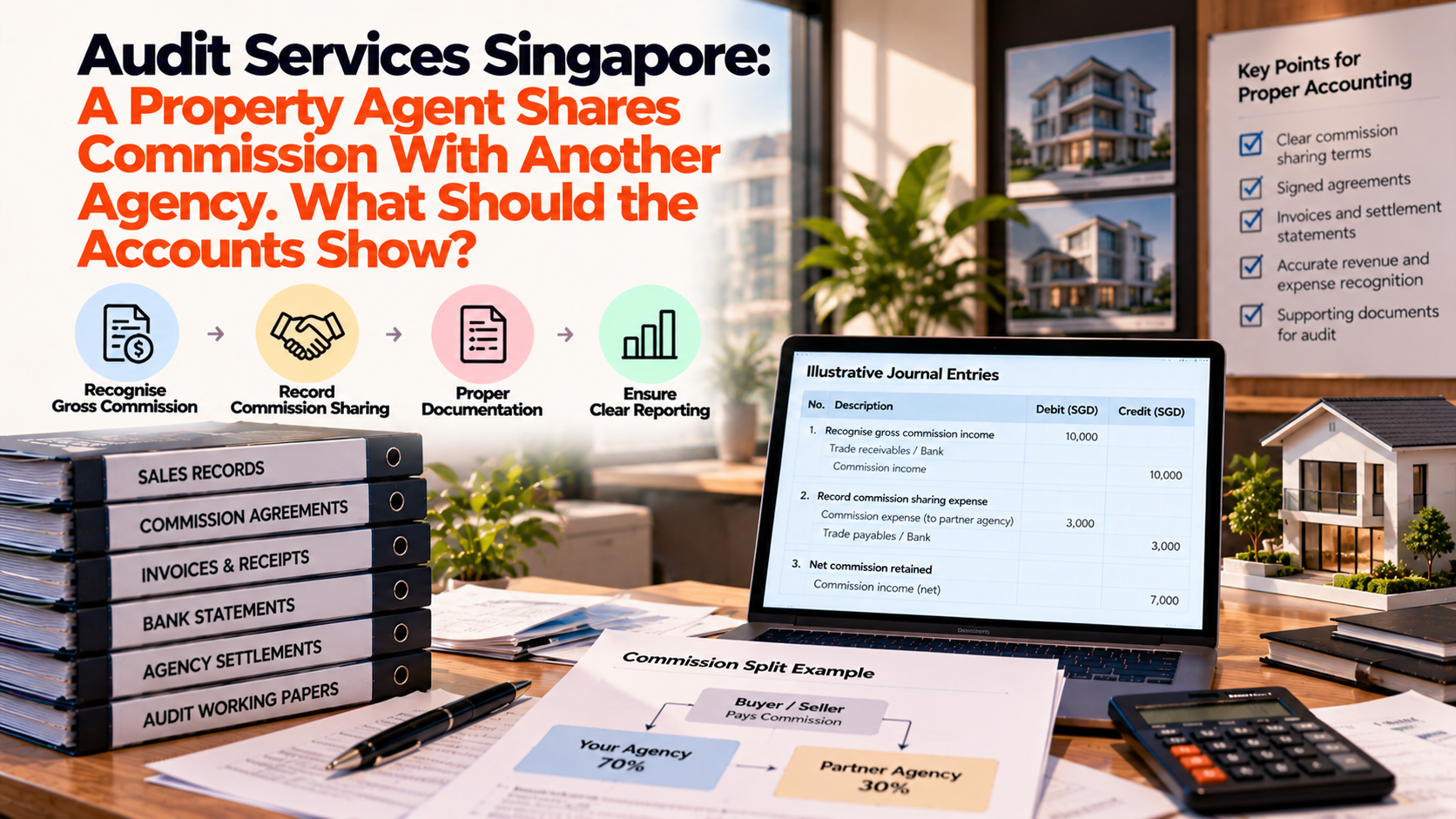
A property transaction is completed, the client pays the commission, and part of that amount is passed to another agency under a commission-sharing arrangement. From an operational perspective, the transaction may appear straightforward. Finance receives the payment details and records what remains after the split.
However, the amount retained in the bank does not necessarily determine the revenue that belongs in the accounts. The agency needs to understand its contractual entitlement, the services each party provided and any obligation to pay the other agency. These matters also affect outstanding receivables, expenses and year-end reporting.
Lee & Hew provides financial statement audit services through Audit Services Singapore. For property agencies preparing their accounts, clear agreements and transaction-level reconciliations help explain the figures behind commission receipts. The objective is to show the substance of the arrangement, rather than rely on the cash movement alone.
Identify the Reporting Entity and the Parties Involved
The term “property agent” is often used informally to describe an individual salesperson. The financial statements under review, however, may belong to the estate agency company. Begin by distinguishing the company’s transactions from the remuneration arrangements of its salespersons.
Identify the client, the agency engaged by that client, the other agency involved and the individuals handling the transaction. Record who has the right to invoice, who receives payment and who owes an agreed share to another party.
These distinctions matter because several separate arrangements may exist around one property transaction. A payment between agencies is not necessarily the same as a salesperson’s commission entitlement. Combining them into one net figure can conceal the company’s actual revenue and obligations.
Use consistent legal names and transaction references in the records. This reduces confusion when correspondence refers to individuals while invoices and payments relate to their respective agencies.
Start With the Client Agreement and Commission-Sharing Terms
CEA describes co-broking as property agents representing different parties working together to complete a transaction for their respective clients. A commission-sharing arrangement therefore needs to be understood alongside the services and relationships involved.
Retain the relevant client agreement and the documented arrangement between agencies. Identify the agreed fee, sharing basis, payment conditions and any amendments. Do not assume that an informal reference to “the usual split” establishes the terms for every transaction.
Check whether the sharing arrangement is a percentage of the commission, a fixed amount or subject to conditions. Clarify the treatment of discounts or later changes agreed with the client. A reduction in the client’s fee may not automatically produce the same reduction in the amount owed to the other agency.
The accounting team needs the final agreed position. If terms change through correspondence after the original agreement, preserve that evidence and make the change visible in the transaction schedule.
A Property Agent Is Not Automatically an Accounting Agent
The industry description “agent” does not settle the principal-versus-agent assessment used in revenue accounting. That assessment concerns the particular service promised to a customer and whether the entity controls it before transfer.
Under revenue guidance, a principal recognises the relevant revenue gross, while an agent recognises its fee or commission for arranging the service. Management must identify the specified service and assess the arrangement before deciding which presentation applies.
Receiving the full payment is not conclusive evidence of being principal. Equally, sharing commission does not automatically mean the company should report only the amount retained. Contracts, responsibilities and the substance of the service matter.
Document the reasoning for significant arrangements. Where transaction types differ, avoid applying one conclusion across the entire agency simply because payments flow through the same bank account.
Use a Numerical Example to Separate Presentation From Cash
Consider a hypothetical transaction in which Agency A receives S$30,000 and agrees to pay S$12,000 to Agency B. Assume the figures exclude GST and salesperson remuneration. Agency A retains S$18,000 after paying Agency B.
If the assessed facts establish that Agency A earned the full S$30,000 for its service and incurred a separate S$12,000 commission-sharing expense, its records would show those amounts separately. The S$18,000 would represent the difference before other costs, not its total revenue.
If different contractual facts establish that part of the receipt was collected on behalf of another party and Agency A’s own revenue entitlement is S$18,000, a different presentation may be appropriate. That conclusion needs evidence; it cannot be selected because it produces a simpler entry.
The example illustrates why the bank balance is insufficient. The same cash movement can require different analysis depending on the underlying rights and obligations. It is not a rule that every co-broking arrangement permits either treatment at management’s discretion.
Keep Revenue Timing Separate From Payment Timing
A client invoice, property transaction milestone and cash receipt may occur on different dates. The accounting assessment should establish when the relevant service obligation is satisfied and what conditions affect the fee.
Review the actual agreement rather than assuming that every transaction follows the same recognition point. A statement that the deal is “closed” in the sales system may not explain the contractual position sufficiently for finance.
The sharing payment also needs its own timing assessment. Where an obligation to the other agency has arisen, delaying payment does not by itself remove that obligation from the accounts. Conversely, an advance payment does not automatically establish that the related service has already been received.
Prepare a timeline for material transactions around year-end. Show the relevant service milestones, invoices, receipts and payments, with supporting documents. This makes differences in timing easier to explain.
Reconcile Each Transaction From Fee to Final Settlement
A commission schedule should connect the client fee to the amount billed, cash received, agreed sharing amount and outstanding balances. Include credit notes, refunds and other adjustments where applicable.
Reconcile the schedule to both the revenue records and the relevant receivable or payable accounts. A schedule that explains cash receipts but ignores unpaid commissions gives only part of the picture.
Investigate differences rather than carrying them forward as miscellaneous amounts. A discrepancy may arise from a partial payment, a changed split or an invoice posted under the wrong transaction reference. Each requires a different correction.
Keep evidence of approval for adjustments. Finance should be able to explain why the final amount differs from the original agreement without relying on a salesperson’s recollection months later.
Review Outstanding Amounts Between Agencies
An unpaid commission-sharing balance may reflect normal payment terms, a disagreement about entitlement or a delay in receiving money from the client. Establish which explanation applies.
Record the amount acknowledged by the counterparty separately from any disputed portion. Retain correspondence showing the issue and management’s assessment. A balance should not be treated as settled merely because the people involved expect to resolve it informally.
Where the agreement links payment to client collection, examine the wording and accounting implications rather than assuming the payable only exists when cash arrives. A payment condition and the existence of an obligation are related questions, but they are not always identical.
For amounts receivable from another agency, assess recovery using current evidence. Subsequent receipts, settlement correspondence and relevant contractual terms help support the recorded balance.
Handle Discounts and Disputes Without Losing the Original Trail
A client may negotiate a lower commission, challenge the service or request a refund. These developments can affect the client balance and potentially the sharing arrangement, but their effects need to be established separately.
For example, Agency A agreeing to reduce its client invoice does not prove that Agency B has accepted a lower sharing payment. Finance needs evidence of both positions before adjusting both sides.
Maintain a record of the original fee, subsequent amendment and reason for the change. Where a credit note is issued, link it to the relevant invoice and transaction. Avoid overwriting the original schedule so that the history disappears.
Distinguish a genuine fee reduction from difficulty collecting an otherwise valid amount. The accounting considerations differ, and an overdue balance should not automatically be treated as a commission discount.
Separate Agency Sharing From Salesperson Remuneration
After accounting for the client fee and co-broking arrangement, the agency may still owe remuneration to its own salesperson. The calculation may depend on internal agreements, collection conditions or other deductions.
Keep that calculation identifiable. A single entry for “net commission” can combine revenue, payments to another agency and salesperson remuneration without showing how any component was determined.
Retain the applicable remuneration terms and approvals. Where deductions or adjustments are made, explain their basis and connect them to the transaction. This helps prevent a change in the external commission split from being applied incorrectly to an internal payout.
Clear separation also improves management reporting. Directors can review revenue, external sharing costs and internal remuneration without mistaking the final cash retained for the profitability of the transaction.
Keep GST and Invoice Details Distinct
Where GST applies, the records should distinguish tax amounts from the underlying commission and sharing figures. Confirm the relevant parties’ registration status, invoicing responsibilities and applicable tax treatment before finalising the entries.
Avoid calculating a commission split using a tax-inclusive total unless that is the agreed and appropriately assessed basis. A small inconsistency in how teams interpret the split can create differences between the invoice, payment request and ledger.
Retain the appropriate invoices and credit notes. The accounting conclusion on gross or net revenue does not, by itself, answer every GST question. Tax treatment requires its own assessment under the applicable rules.
For management schedules, use clearly labelled amounts so reviewers can see whether figures include or exclude tax. This is particularly useful when comparing transactions involving different counterparties.
Preparing Records for Audit Services Singapore
For a significant commission transaction, the audit file should provide a clear path from the ledger to the client agreement, sharing arrangement and supporting evidence of performance. Include invoices, receipts, payments and material correspondence.
Where management has made a gross-versus-net assessment, retain the reasoning and relevant contractual references. A short, supported explanation is more useful than an assertion that the agency has always recorded transactions that way.
Lee & Hew’s financial statement audit services provide independent examination of financial reporting. Management remains responsible for complete records and the accounting judgements reflected in the statements. The audit does not replace the agency’s responsibility to establish its contractual position.
Discuss unusual or material arrangements early. Transactions with changing terms, unresolved disputes or several participating agencies may require more attention than routine transactions covered by an established process.
Review Later Settlements Before Completing the Accounts
Payments and credit notes after year-end may provide information relevant to balances recorded at the reporting date. Keep those developments available to finance and the auditor while the accounts are being prepared.
A later settlement can help explain a difference between agencies, but its effect needs assessment in the circumstances. Do not assume that every later payment changes the previous year’s figures or that every later dispute belongs entirely to the new period.
Maintain a dated history showing what was agreed and when. This allows management to distinguish the position at year-end from subsequent changes in terms.
The same record is useful operationally. It helps the agency track unresolved matters and prevents duplicate payments when a settlement is processed separately from the original commission schedule.
Build a Consistent Commission Reporting Process
A reliable process begins when the transaction is accepted, not when the bank receipt arrives. Establish who records the client agreement, who confirms the sharing terms and who notifies finance of amendments.
Use a common transaction reference across the sales records, invoices and payment schedules. Require review of significant differences and keep unresolved items visible until they are supported or corrected.
Management reporting can then explain how revenue translates into the amount retained after sharing costs and remuneration. This provides a clearer view of performance without changing the accounting presentation simply to suit a preferred margin.
Through Audit Services Singapore, Lee & Hew connects its audit work with the need for understandable, supported financial statements. Better transaction records give management a stronger basis for explaining both revenue and outstanding obligations.
Make the Accounts Reflect the Agreement
Sharing commission is a commercial arrangement with accounting consequences. The amount received, the amount passed on and the amount retained each provide useful information, but none alone determines the correct reporting.
Before closing the accounts, review the contractual rights, establish the services provided and reconcile the balances between parties. Document significant judgements and investigate differences before they become recurring year-end questions.
Speak with Lee & Hew through Audit Services Singapore about its financial statement audit services. A clear connection between agreements, transaction records and accounting entries helps property agencies present their commission activity accurately and explain what remains receivable or payable.