
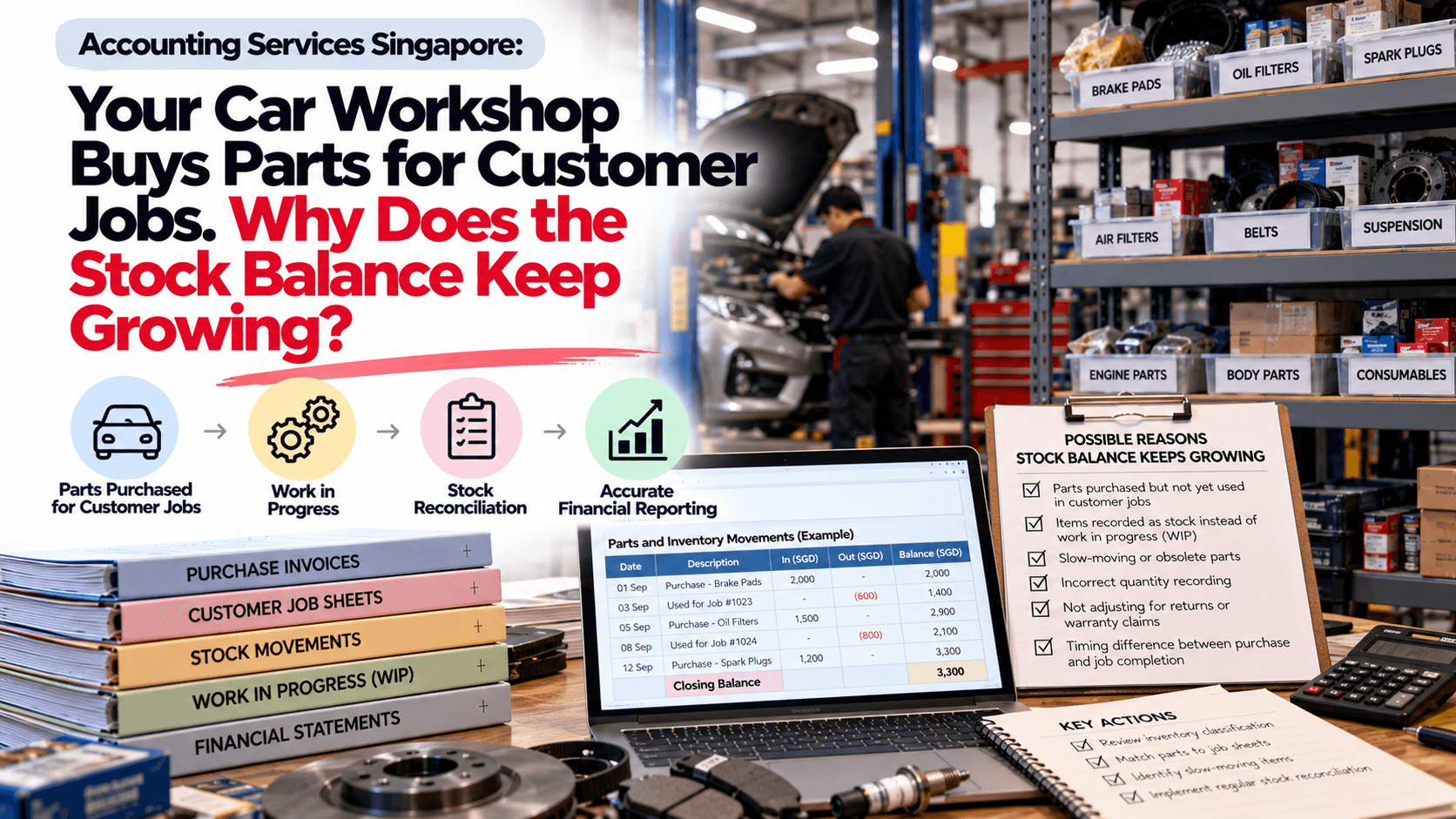
Your workshop is busy, vehicles are leaving on schedule, and suppliers keep delivering parts for approved repairs. Yet the monthly accounts show an inventory balance that continues to rise. Some shelves are crowded with unopened boxes, while other parts shown in the system cannot immediately be located.
The owner’s first concern is usually cash. If parts are being bought for customer jobs, why is so much money still sitting in stock? The answer may involve genuine overbuying, but it could also involve incomplete job records, unprocessed returns or parts already fitted to vehicles that remain in the inventory system.
Lee & Hew provides accounting, bookkeeping and management accounts services. For a workshop, those services are most useful when the financial records connect with the operational journey of a part: ordered, received, assigned, fitted, returned or retained for future use.
That connection matters when choosing accounting services Singapore businesses can rely on. A stock total becomes useful when management can explain what it contains, why it changed and what action the business needs to take.
A Growing Balance Can Point to Different Problems
An increase in inventory is not automatically a sign of poor purchasing. Your workshop may be handling more jobs, preparing for confirmed work or holding essential parts to reduce repair delays. Those reasons should be visible in the records.
However, stock can also grow because purchases are recorded promptly while usage is updated late. The accounts then show parts as available even though technicians have already installed them and the customer has collected the vehicle.
Other items may physically remain in the workshop after jobs are cancelled or specifications change. These are different from recording errors because the stock exists, but its future use may be uncertain.
Separate these causes before deciding on a remedy. Cutting purchases will not correct missing usage entries, while updating the system will not release cash from parts that nobody expects to use.
Follow Each Purchase Back to a Job or Stock Requirement
A purchase order should explain why the workshop is buying the part. For job-specific orders, record the job reference and the vehicle details needed to identify the correct component. For general stock, record the replenishment reason.
This distinction helps management review outstanding items. A part purchased for a confirmed repair has a different purpose from one bought because a supplier offered a quantity discount.
Keep changes visible. If the customer declines the repair or the diagnosis changes, update the part’s status rather than leaving it permanently assigned to an open job. Someone should decide whether it can be returned, used elsewhere or retained with a clear reason.
A practical accounting process starts with this operational information. Lee & Hew’s accounting and bookkeeping support can help organise the financial records, while the workshop team supplies the job details needed to explain each purchase.
Record Receipt, Reservation and Installation Separately
Receiving a part, reserving it for a vehicle and fitting it are separate events. A system that treats them as one step can make it difficult to know what is physically available.
Record the quantity received against the supplier delivery. Then identify parts reserved for particular jobs so that another technician does not assume they are free to use. When parts are issued or fitted, record the movement with the relevant job reference.
Keep the method simple enough for staff to follow during a busy day. A barcode system may help some workshops, while others can begin with a controlled issue record. The important feature is a clear, timely connection between the physical movement and the job.
Review exceptions such as unused parts taken to a work bay and later returned to the shelf. If these movements are not recorded, stock information can become unreliable even when nobody has lost or misused anything.
See How Missing Job Costs Can Overstate the Result
Consider a simplified hypothetical workshop with opening parts inventory of S$40,000. It receives S$30,000 of additional parts during the month. Assuming no other movements, it has S$70,000 of parts cost to account for.
The system records only S$20,000 of parts used on completed jobs, leaving a closing balance of S$50,000. A review then identifies another S$12,000 of parts already fitted to completed and billed repairs but not removed from inventory.
After recording that usage, closing inventory becomes S$38,000 and the parts cost associated with completed work becomes S$32,000. Before the correction, inventory and profit were each overstated by S$12,000 under these assumptions.
The example excludes tax, returns, valuation adjustments and unfinished jobs. It illustrates a recording problem rather than evidence that the workshop necessarily bought too much.
The cash paid to suppliers does not change when the correction is posted. What changes is management’s understanding of the stock still held and the margin earned on the completed work.
Review Unfinished Jobs Without Treating Them as Shelf Stock
Some parts may have been issued to vehicles still being repaired at month-end. They should remain traceable even though they are no longer on the parts shelf.
Identify the status of each material open job. Record work performed, parts used and the reason the job remains incomplete. Finance can then assess the appropriate accounting treatment under the applicable reporting framework and the facts of the repair arrangement.
Do not automatically treat every issued part as an expense at the moment it leaves the shelf. Equally, do not leave it classified as unused shelf inventory simply because the customer has not yet been invoiced.
For inventory sold, the general accounting principle is to recognise its carrying amount as an expense in the period of the related revenue. Accurate job information helps finance apply the relevant requirements rather than relying solely on invoice or payment dates.
Make Supplier Returns and Credits a Closed Process
Incorrect specifications, duplicate orders and cancelled jobs can create supplier returns. Sending the box back is only part of the process. The financial records also need to reflect what the supplier has accepted and credited.
Maintain a return reference connected to the original purchase, dispatch evidence and expected credit. Track items awaiting supplier acceptance separately from credits already issued.
If a supplier applies a handling deduction, record it clearly. A S$500 part returned for a S$450 credit should not leave an unexplained S$50 balance in the purchasing records.
Review outstanding returns regularly. An item that has left the workshop but remains in stock records can inflate inventory, while an unrecorded credit can leave the supplier balance overstated. Clear follow-up prevents a practical return from becoming a long-standing accounting difference.
Separate Customer Property and Exchange Units
A workshop may hold items that are not ordinary inventory available for sale. Customers may supply their own parts, leave removed components for collection or authorise temporary storage while deciding on further work.
Identify these items in the custody records without automatically including them in the workshop’s inventory asset. A physical count needs to distinguish what the business owns from what it is holding for someone else.
Exchange components deserve attention too. A supplier may charge an amount linked to returning an old unit, sometimes described as a core charge. Keep the underlying terms and evidence of return so that finance can assess the resulting balance appropriately.
Using one general stock category for every item in the workshop can obscure these differences. Clear labels and supporting records make the physical count more useful and reduce uncertainty in the accounts.
Check Whether Old Parts Still Support Their Recorded Value
A part can exist in good physical condition and still be difficult to sell or use. It may fit a model the workshop rarely services, have been superseded or lack the documentation needed to confirm compatibility.
Prepare an ageing review showing the last movement, intended use and available return options. Ask the relevant technical staff to explain items that have remained untouched rather than assuming that age alone proves they are worthless.
For ordinary inventory under the applicable full Singapore reporting framework, measurement generally follows the lower of cost and net realisable value principle. Expected selling proceeds and the costs necessary to complete and make the sale need appropriate support.
Avoid applying an unsupported blanket percentage simply to reduce the balance. Document the basis for material adjustments. A write-down improves the accuracy of reporting, but it does not itself recover the cash already spent.
Connect Parts Usage to Job Profitability
A workshop can price labour carefully and still misunderstand job margins if parts costs are missing or assigned to the wrong repairs. A profitable-looking invoice may have consumed more components than the job record shows.
Compare billed parts and actual usage, allowing for agreed bundled pricing. A package price does not mean the underlying components have no cost. Similarly, a part supplied without a separate customer charge may still need to be linked to the job.
Review repeat repairs and warranty-related work separately enough to understand their effect. The objective is to identify the reason for the cost, not to assume every additional part should be charged to the customer.
Lee & Hew’s management accounts services are relevant to this wider reporting need. When job records and accounting entries are connected, owners have a stronger basis for reviewing pricing, purchasing and the work that contributes most to the business.
Use Physical Counts to Investigate the Process
Regular counts can identify differences before they accumulate. Prioritise high-value parts, frequently used items and categories with a history of mismatches, alongside a suitable overall counting plan.
Control movements during the count and retain the original results. Where quantities differ, investigate receipts, job issues, returns and transfers before posting an adjustment.
A repeated shortage in one category may indicate that usage is not being recorded promptly. An apparent surplus may arise because a receipt was missed or an unused part was returned to the shelf without an update.
The count should therefore lead to a process correction where appropriate. Repeatedly adjusting the final number without understanding the cause leaves the workshop exposed to the same problem next month.
Give Purchasing a Clearer View of What Is Already Available
Unreliable stock records can cause unnecessary purchases. Staff may order a part because the system shows none available, even though one is sitting in an unlabelled box or reserved for a cancelled job.
Before placing an order, check available stock and realistic alternatives. Keep compatibility decisions with appropriately qualified staff, while ensuring the outcome is reflected in the stock record.
Review replenishment quantities using actual demand and supplier lead times. A fast-moving service item and an expensive model-specific component should not automatically follow the same buying rule.
Quantity discounts also need a cash assessment. A lower unit price may provide little benefit if the additional stock remains unused or requires a later write-down. The purchasing decision should consider likely consumption, not just the discount offered.
Make the Monthly Stock Review Useful to the Owner
A practical monthly report should explain the movement from opening to closing stock. Show purchases, usage, returns and adjustments, with separate attention to significant open jobs and slow-moving items.
Add information that supports action: parts awaiting return, purchases no longer linked to confirmed work and unresolved count differences. Assign responsibility and a review date to material exceptions.
A useful report does not need to list every low-value item on the owner’s desk. It should highlight where cash is tied up, where records are incomplete and where a purchasing or operational decision is required.
This is the value of connecting accounting services Singapore workshop owners seek with the information generated on the workshop floor. The financial report becomes a basis for managing the business rather than a total that is reviewed only at year-end.
Build a Clearer Parts Picture With Lee & Hew
A rising stock balance may reflect growth, unused purchases or incomplete records. The appropriate response depends on which explanation is supported by the evidence.
Lee & Hew provides accounting and bookkeeping services, management accounts and financial reporting support. For a workshop owner, bringing together supplier records, parts movements and job information creates a stronger starting point for understanding inventory and profitability.
Begin with the largest unexplained balances and the process connecting parts to completed repairs. Then establish a regular review so that new differences are resolved while the supporting information is still available.
Contact Lee & Hew to discuss your accounting and reporting requirements. When the stock balance can be explained part by part and job by job, management is better placed to protect cash, assess margins and buy what the workshop actually needs.