
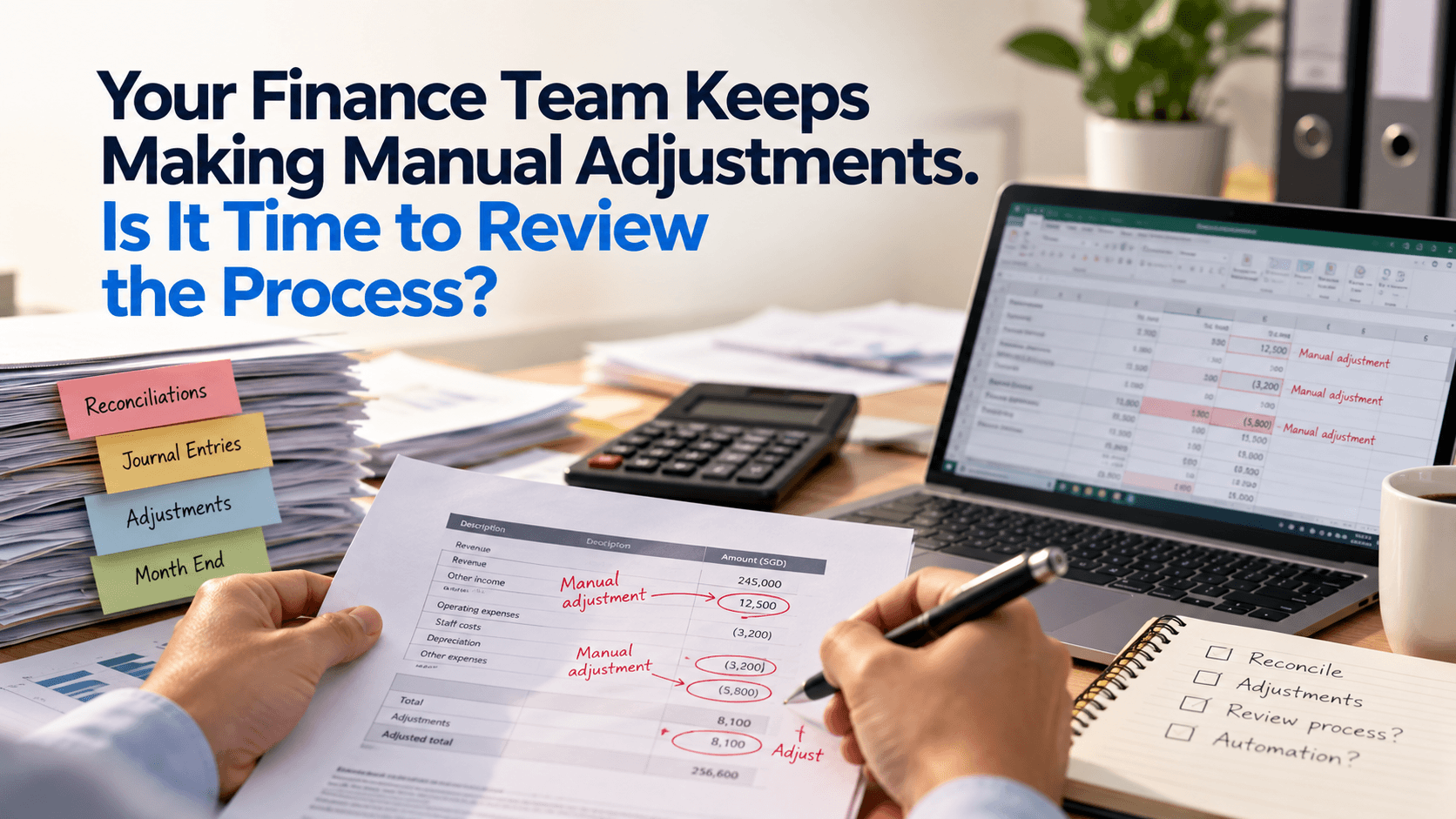
The monthly accounts are nearly ready, but finance needs another day to make adjustments. A supplier expense has been recorded under the wrong department, payroll figures need to be reallocated, and a spreadsheet total does not agree with the accounting system. The team resolves the differences, issues the report, and repeats a similar exercise the following month.
For a business owner, this can be frustrating. You have invested in accounting software and employed people to maintain the records, yet producing reliable figures still seems to involve considerable manual work.
Manual adjustments are a normal part of accounting. The question is why they are needed, whether they are properly supported, and whether the same avoidable problems keep returning. Reviewing that pattern can help management identify where the process needs attention.
Understand What the Team Means by an Adjustment
Before deciding that something is wrong, ask finance to explain the types of adjustments being made. A manual journal entry can record a legitimate accounting adjustment, correct an error, or deal with a transaction that the system does not process automatically.
Some entries reflect the timing of income and expenditure. Others involve estimates, allocations, or unusual transactions. These activities can require professional judgement even when the underlying software is working correctly.
There is a meaningful difference between recording a supported month-end accrual and repeatedly correcting invoices posted to the wrong account. Both may appear in a journal listing, but they point to different management questions. Understanding their purpose should come before setting a target to reduce their number.
Separate Necessary Accounting Work From Repeated Corrections
Ask the team to group recent adjustments by reason. Useful categories might include routine period-end entries, estimates, corrections, allocations, and system-related issues. The categories should help explain the work without becoming another complicated reporting task.
For example, a recurring monthly allocation may be appropriate where several departments share an expense. Repeatedly correcting the same supplier’s invoices could indicate that a default account code or processing instruction needs to change.
The number of entries alone is a poor measure of performance. A complex business may require substantial legitimate adjustment work, while a simpler company may have fewer entries but weak supporting records. Focus on whether the entries are necessary, understandable, and consistently reviewed.
Follow One Recurring Problem Back to Its Source
Choose an adjustment that appears regularly and trace the transaction from its beginning. Identify who supplied the information, how it entered the accounting system, and where the original treatment became incorrect or incomplete.
Suppose freight invoices are repeatedly recorded as general administrative expenses before finance moves them into the appropriate cost category. The cause might be a supplier default, unclear coding guidance, or incomplete information on the invoice approval.
Correcting the current month remains necessary, but management should also assign responsibility for preventing the next occurrence. Otherwise, the adjustment becomes a permanent task that everyone accepts without examining why it exists.
Check Whether Information Arrives Too Late
Some adjustments arise because finance does not receive complete information before the reporting deadline. A project manager may confirm work completed only after the accounts are drafted, or an operations team may submit supplier documents late.
Review the information flow across departments. Identify what finance needs, who provides it, and the date by which it must arrive. Make those responsibilities part of the monthly timetable rather than leaving the accountant to chase each item individually.
Consider a project whose subcontractor invoice arrives after month-end. Finance may need to estimate the cost of work already performed using available evidence. A timely update from the project manager can support that estimate, even if the invoice itself is not yet available.
Examine What Happens When an Estimate Is Replaced
Estimates need a clear follow-up process. When the actual invoice or other evidence arrives, the team should understand how it relates to the amount previously recorded and whether a reversal or adjustment is required.
Imagine a simplified case in which finance accrues S$8,000 for completed services and later receives an invoice for S$8,400. Depending on the accounting workflow, the team needs to clear or reverse the accrual and record the actual expense without counting both amounts as separate costs.
If nobody tracks the original estimate, duplicate expenses or unexplained balances can remain. Maintain a schedule showing the basis, period, responsible person, and resolution of significant accruals. An estimate should have an identifiable path from preparation to settlement or reassessment.
Review the Spreadsheets Supporting the Accounts
Spreadsheets can be useful for calculations, allocations, and supporting schedules. Problems arise when important figures depend on files that only one person understands or when changes cannot be traced.
For each significant workbook, identify its data sources, manual inputs, calculation method, and review checks. Confirm which version is current and how its totals agree with the accounting records. Avoid relying on a filename such as “final latest revised” to communicate status.
For example, a department allocation workbook may contain percentages copied from an earlier year. If the business has changed, the formula can still calculate correctly while using an outdated basis. The review should therefore consider the assumptions as well as the arithmetic.
Look for Adjustments Made Only in Management Reports
Sometimes the ledger remains unchanged while finance adjusts figures in a separate reporting spreadsheet. Such adjustments may serve a legitimate reporting purpose, but they need a clear explanation and reconciliation.
Management should understand whether a report shows the accounting result, an adjusted performance measure, or a combination of both. A difference between the ledger and a management presentation should be visible rather than buried in a formula.
Suppose management wants to see operating performance before a specific one-off cost. The report can show that measure with a clear bridge to the recorded result. Quietly removing the expense from a spreadsheet total makes it harder for readers to know what they are looking at or compare periods consistently.
Make Supporting Explanations Useful to Another Person
A journal description such as “monthly adjustment” provides little help to someone reviewing the accounts later. The person who prepared it may remember the reason today, but the explanation should remain understandable after a handover or several months have passed.
Supporting records should identify the purpose, amount, relevant period, accounts affected, and basis of calculation. Where the entry corrects an error, explain the original issue and link it to the source transaction.
Documentation does not need to be lengthy for every routine entry. It needs to be sufficient for an appropriate reviewer to understand what was done and why. A concise explanation linked to a reliable schedule is more useful than a large folder of unrelated attachments.
Give Reviewers Something Meaningful to Check
Approval should involve more than confirming that an entry balances. A journal can have equal debits and credits while still using the wrong amount, period, account, or underlying assumption.
Define review expectations according to the nature of the entry. A routine allocation might require a check of the current basis and reconciliation, while an unusual transaction may require a more detailed accounting assessment. Give reviewers access to the relevant evidence.
Where the team is small, determine who can provide an effective review and when specialist assistance is needed. Avoid treating a manager’s approval as technical accounting review if that person does not have the knowledge required to assess the issue.
Be Careful With Unexplained Balancing Entries
An adjustment made solely to force two totals to agree deserves investigation. Agreement achieved through an unsupported entry can conceal the difference rather than resolve it.
Suppose a reconciliation shows an unexplained S$3,000 difference. Posting that amount to a miscellaneous expense account might make the schedule balance, but management still does not know what caused the discrepancy or whether the treatment is correct.
Assign an owner to investigate unresolved differences and record the work performed. Any decision to correct, write off, or otherwise account for an amount should have a supportable basis and appropriate approval. The pressure to finish a report should not replace that assessment.
Check the System Before Buying a New One
Repeated manual work may reveal a system limitation, but it can also result from configuration, training, or inconsistent use. Establish the cause before assuming that replacing the software will solve the problem.
Review recurring account mappings, data imports, integration settings, and transaction workflows. If an import consistently sends payroll costs to the wrong department, correcting the mapping may be more effective than adding another month-end journal.
Test proposed changes before relying on them in live reporting. Confirm that the results are complete, accurate, and reconcilable. Automation can repeat an incorrect rule efficiently, so reducing manual effort should go together with checking the quality of the output.
Understand the Effect on Business Decisions
The practical concern is what repeated corrections do to the information management uses. Adjustments may change margins, project results, departmental spending, or the apparent amount owed by customers.
Imagine approving additional work for a project because its initial report shows a healthy return. If a later adjustment adds previously omitted subcontractor costs, the decision may have been based on an incomplete picture.
Identify which recurring issues could affect decisions before the accounts are finalised. Where figures remain provisional, explain the uncertainty and likely areas of change. Management can then judge whether to proceed, seek more information, or wait for a specific matter to be resolved.
Choose a Small Number of Improvements First
A review can generate a long list of issues, but attempting to fix every process at once may overwhelm the team. Prioritise problems by their financial impact, recurrence, and the effort needed to resolve them.
For example, the first improvement might be a supplier coding rule, followed by a monthly project-cost submission deadline and a clearer accrual tracking schedule. Assign an owner and completion date to each action.
Keep the necessary accounting adjustments in place while the improvements are being implemented. Removing entries before fixing their cause could make the reports less reliable. The goal is to reduce avoidable correction work while preserving proper accounting treatment.
Measure Whether the Process Has Improved
After making changes, review the next few reporting cycles. Look for fewer repeat errors, clearer supporting records, more timely information, and less time spent investigating the same differences.
Do not judge success solely by the total journal count. The business may still need routine accruals, allocations, and other supported entries. A more useful indicator is whether staff can explain the remaining adjustments and whether recurring problems have genuinely reduced.
Also check for work that has moved elsewhere. If finance posts fewer journals but spends more time altering reports outside the ledger, the underlying workload or risk may not have improved. Review the complete reporting process rather than one visible stage.
Bring the Discussion Back to Reliable Accounting
Lee & Hew PAC provides accounting services covering day-to-day records and management reporting, alongside its audit and other professional services. A practical discussion can begin with the adjustments your team makes most often and the information needed to understand them.
Bring a sample journal listing, supporting schedules, recent reconciliations, and examples of recurring corrections. Explain which parts of the monthly process take the most time and which changes have affected management’s interpretation of results. This provides a concrete basis for discussing accounting support or a defined review.
Manual adjustments do not automatically mean the finance function is failing. The reason to review the process is that repeated, poorly explained corrections can consume time and weaken confidence in the reports. Understanding their causes helps the business retain necessary accounting judgement while reducing work that should not need to be repeated every month.